🕵♂ A Hidden Identity, A Real Passport
What happens when your name appears on an Interpol red notice—and you’re not a criminal? For dozens of Bosnian citizens, this nightmare became real.
An investigation by the Center for Investigative Reporting (CIN) uncovered a sprawling scheme where high-profile Balkan gang members secured authentic Bosnian passports using stolen identities. The cost? Innocent lives disrupted, governments blindsided, and global borders breached.
🔎 How Did It Happen?
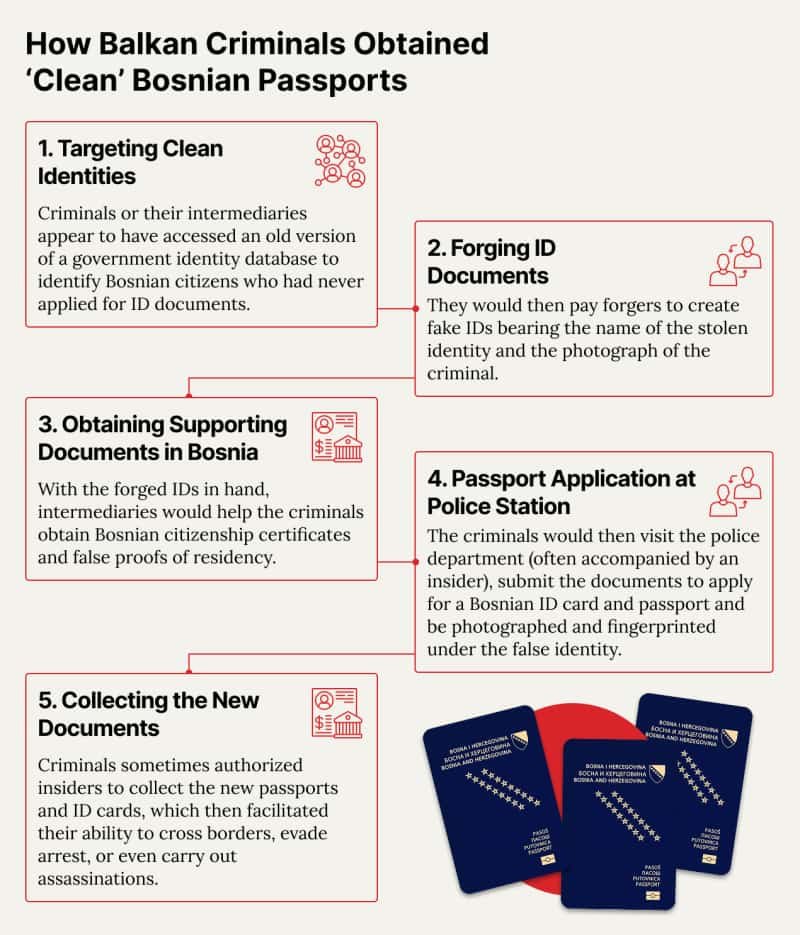
Between 2013 and 2022, at least 60 members of the region’s most violent criminal networks obtained Bosnian passports under fake identities. Names were stolen, photographs swapped, and systems exploited.
The gangs exploited weak interagency coordination within Bosnia’s decentralized bureaucracy. Insiders accessed a government ID database (IIDDEEA) to find Bosnian citizens—usually living abroad—who had never applied for identity documents. With no fingerprints on record, these individuals were ideal targets.
🧾 Step-by-Step Fraud
- Database Access: Criminals or their middlemen accessed personal data through compromised systems or corrupt officials.
- Target Selection: They selected citizens unlikely to report identity theft—often living in Serbia or elsewhere.
- ID Forgery: Fake ID cards were produced bearing the real person’s name but the gangster’s photo.
- Paper Trail Creation: The gang obtained residency and citizenship certificates using false information.
- Official Passport Issuance: With all documents in hand, they applied for real Bosnian passports.
Once the passport was in hand, the gangsters could cross borders undetected.
🚨 The Kavač Clan’s Clean Identities
In 2021, Radoje Živković, a known Kavač clan member, walked into a police station in Banja Luka and applied for a passport using the identity of Andrej Jović—a real person who had relocated to Serbia years earlier.
Behind this act was former police officer Dalibor Ćurlik, who declared Živković’s residence at his mother’s home and assisted throughout the process. Surveillance footage even captured the fingerprinting session. Once the passport was ready, Živković flew to Istanbul.
Weeks later, in that same city, the leader of the rival Škaljari gang, Jovan Vukotić, was assassinated. Turkish authorities later discovered Živković’s passport—issued in Jović’s name—on him.
Ćurlik wasn’t working alone. He helped other criminals acquire documents using the same formula: fake address, falsified papers, and personal escort to the police station.
🧩 The Škaljari Scheme in Brčko
While Kavač operated in Banja Luka, the Škaljari gang had their own network in Brčko. There, Serbian national Nikola Vein acted as the fixer. In 2020 alone, at least 12 gang members obtained passports via this route. Vein allegedly charged €5,000 per document.
Vein’s own track record? A Croatian court sentenced him in 2024 for facilitating 75 fake passports worth over €500,000. Despite his conviction, neither Serbia nor Bosnia has extradited him.
When contacted, Vein denied all charges. “I don’t read newspapers,” he told reporters.
👤 Victims: The Real Owners of the Stolen Names
For the criminals, these documents were a ticket to mobility and concealment. For their victims, it meant police interrogations, border delays, and bureaucratic hell.
One man, Predrag Đurđević, never applied for a Bosnian passport. Yet police showed up at his Serbian home after his name appeared in a fraud investigation. His cousin, Đurađ Trivunović, was stopped twice at the Bosnian border in 2022, accused of being an internationally wanted drug trafficker.
“I’m still flagged,” Trivunović says. “Even with proof, I don’t know when it’ll stop.”
🎯 Why This Matters
Bosnia’s fragile governance structure, a legacy of the Dayton Peace Agreement, leaves gaps in data protection and document security. Without centralized oversight, criminal groups exploit the cracks.
The issue is no longer local. These passports gave mobility to murderers, traffickers, and fugitives who committed crimes far beyond the Balkans—from Istanbul to Corfu.
🔐 What Needs to Change
- Database Security: Access to sensitive citizen data must be monitored and limited.
- Cross-Border Cooperation: Extradition agreements and alerts need urgent improvement.
- Victim Protections: Affected citizens should have a fast-track system to clear their names.
- Forensic Verification: Real-time biometric checks could block mismatched identities.
📌 Final Thought
In the world of organized crime, identity is power. For Balkan gangs, Bosnia’s fragile infrastructure provided a golden opportunity. For citizens, it exposed a terrifying truth: your name could be used in crimes you never committed.
👁 Want to learn how OSINT tools can help uncover these frauds and verify identities online?
👉 Explore our full OSINT investigations on hidden identities and document fraud.
- Banner: Željko Todorović/CIN, James O’Brien/OCCRP