


Search is no longer just a list of links.
With AI Mode and AI Overviews, Google is turning search into a conversational interface: the user asks a question, the system reads across the web, summarizes the answer, adds a few links, and invites a follow-up. At Google I/O 2026, the company described this as a major shift in Search, with AI Mode becoming more agentic and capable of monitoring information across blogs, news sites, social posts, finance, shopping and sports data.
For ordinary users, this may feel faster.
For OSINT analysts, journalists and researchers, it creates a methodological problem: the source can disappear behind the summary.
The issue is not simply that AI answers may be wrong. That risk already exists. The deeper issue is that AI-mediated search can weaken the chain of evidence. It can compress multiple sources into one fluent paragraph, hide uncertainty, flatten disagreement, and make it harder to understand where a claim came from, when it was observed, and whether it can still be independently verified.
In OSINT, that chain matters.
A useful answer is not the same thing as a documented finding.
From Search Results to Synthetic Answers
Traditional search gave investigators a visible starting point: ranked pages, snippets, URLs, dates, domains, caches, and sometimes competing versions of the same claim. It was imperfect, biased and shaped by ranking systems, but it still forced the analyst to move through sources.
AI Mode changes the first layer of contact.
Instead of beginning with a source, the user begins with a generated interpretation of sources. The interface becomes conversational. Follow-up questions can keep the user inside the AI layer rather than pushing them outward to the original pages.
Google has tried to address this by adding more visible links and source previews in AI Overviews and AI Mode. In May 2026, Google said it was updating its AI search features to help users access original content and trusted sources more easily, including links from news subscriptions and contextual links near specific points in generated answers.
That helps. But it does not remove the OSINT problem.
A link inside an AI answer is not the same as an evidence trail. It may point to a useful source, but the analyst still has to determine whether that source actually supports the claim, whether the AI combined it with other sources, whether the original page has changed, and whether the answer omitted contradictory evidence.
This is where OSINT discipline becomes more important, not less.
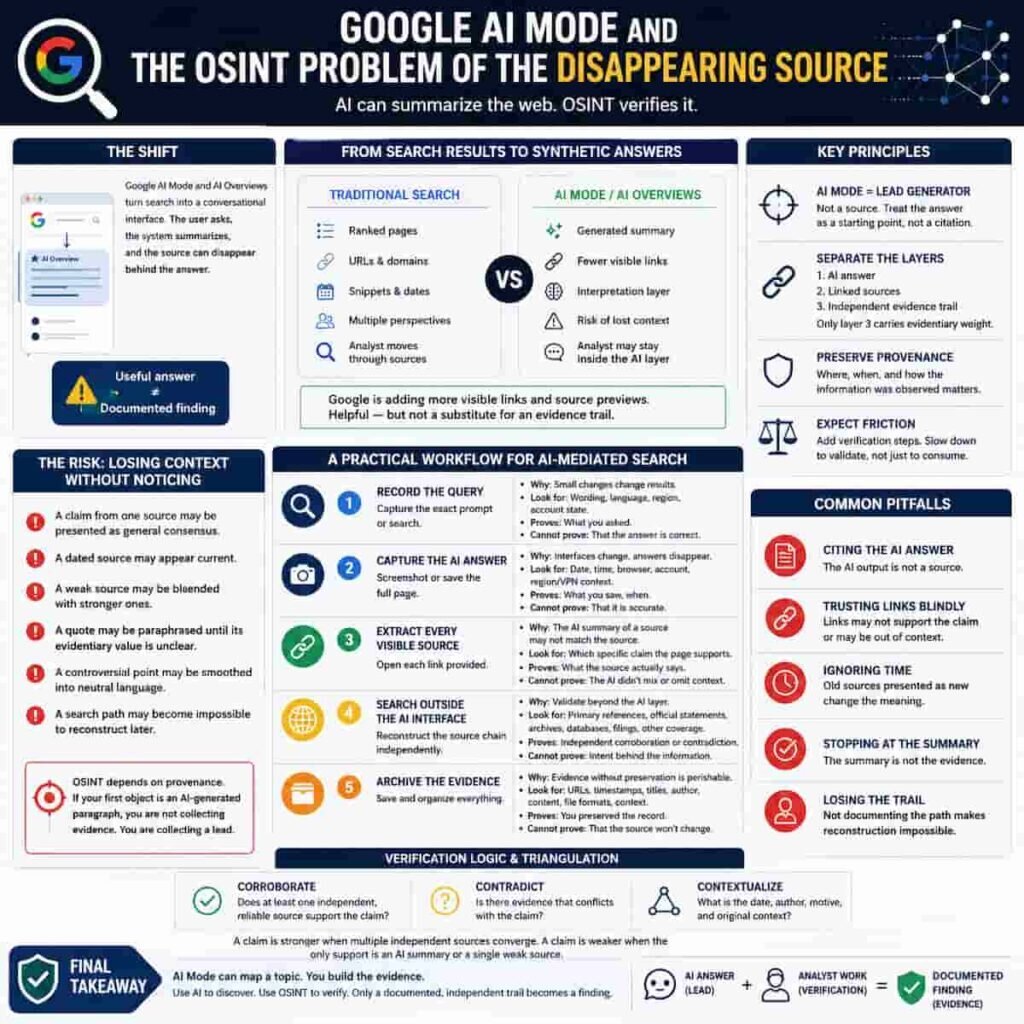
The Risk: Losing Context Without Noticing
AI search systems are designed to reduce friction. OSINT often requires adding friction back.
When an AI system summarizes a topic, several things can happen:
- A claim from one source may be presented as general consensus.
- A dated source may appear current.
- A weak source may be blended with stronger ones.
- A quote may be paraphrased until its evidentiary value is unclear.
- A controversial point may be smoothed into neutral language.
- A search path may become impossible to reconstruct later.
For a casual user, this may be acceptable.
For an investigator, it is a failure mode.
OSINT depends on provenance: where information came from, how it was found, what was visible at the time, and how it was verified. If the first object you collect is an AI-generated paragraph, you are not collecting evidence. You are collecting a lead.
That distinction should shape the workflow.
Treat AI Mode as a Lead Generator, Not a Source
AI Mode can still be useful. It can help map a topic, identify possible entities, surface search terms, suggest angles, and reveal how a platform is currently framing a public issue.
But the output should be treated as a lead, not as a citation.
A practical OSINT workflow should separate three layers:
1. The AI answer
What the system claims.
2. The linked sources
What the interface provides as support.
3. The independent evidence trail
What the analyst verifies outside the AI layer.
The third layer is the only one that should carry evidentiary weight.
If AI Mode says a company was involved in a data breach, the next step is not to cite the AI answer. The next step is to open the linked sources, search independently for primary references, check company statements, regulatory filings, breach notifications, security reports, archived pages, and timestamps.
The AI answer may be useful. It is not the finding.
A Practical Workflow for AI-Mediated Search
When using AI Mode or AI Overviews in an OSINT investigation, document the search process as if the interface might change tomorrow.
Start with the query.
Record the exact wording of the prompt or search. AI systems can respond differently to small changes in phrasing, location, language, account history and personalization settings. If the result matters, the query matters.
Then capture the generated answer.
Take a screenshot or save the page as a PDF. Include the date, time, browser, account state if relevant, and region or VPN context. This does not make the AI answer reliable, but it preserves what you saw.
Next, extract every visible source.
Open each linked page in a separate tab. Do not rely on the AI summary of that source. Read the page directly and identify which specific claim it supports. If a link does not support the claim, note that.
Then search outside the AI interface.
Use standard search, site-specific queries, archives, official databases, domain records, social platform search, news databases, or specialized OSINT tools depending on the topic. The goal is to reconstruct the source chain without depending on the AI layer.
Finally, archive the evidence.
Use web archives where appropriate. Save URLs, timestamps, page titles, authors, publication dates, screenshots and extracted text. If a page is dynamic, document what was visible and what may not be reproducible.
A simple evidence log can include:
- Query used
- AI answer captured
- Visible links provided by AI Mode
- Original URLs opened
- Claims supported by each source
- Claims not supported
- Independent sources found
- Archive links
- Date and time of collection
- Confidence level
This turns AI-mediated search from a black box into a documented research step.
Why This Matters for Source Evaluation
A recent research paper on Google AI Overviews measured activation, source quality, claim fidelity and publisher impact across more than 55,000 trending queries over a 40-day window in 2026. The study reflects a broader concern: when search engines synthesize answers, they gain more editorial power over what users read first.
For OSINT, the key question is not whether AI search is convenient.
The key question is whether the analyst can still audit the path from claim to source.
This is especially important in investigations involving breaking news, conflict footage, sanctions, cyber incidents, elections, disinformation, public records, corporate ownership or online identities. In these contexts, source order, publication time, original wording and document version can change the interpretation.
A generated answer may erase those differences.
For example, if three sources report the same event, but one is an official statement, one is a media summary, and one is a social media claim, an AI answer may merge them into one coherent paragraph. That coherence can be misleading. The analyst must separate the layers again.
Personalization Is Another OSINT Variable
AI search also introduces a personalization problem.
If an AI system adapts answers based on user context, subscriptions, location, language, account history or previous searches, two analysts may not see the same result. That does not make the system unusable, but it makes documentation more important.
In traditional OSINT, analysts already account for personalization through clean browsers, logged-out sessions, VPNs, multiple devices, and regional comparisons. AI Mode adds another layer: the generated synthesis itself may vary.
A serious workflow should therefore include comparison:
- Run the query logged in and logged out.
- Compare AI Mode with standard search.
- Test different regions or languages when relevant.
- Save the visible source set for each version.
- Note whether the answer changes or only the citations change.
The goal is not to eliminate variation. The goal is to detect it.
The New OSINT Skill: Reopening the Source Chain
AI search does not remove the need for OSINT. It changes where OSINT begins.
The analyst’s task is no longer only to find information. It is also to reopen the path behind a generated answer.
That means asking:
- What exact claim is being made?
- Which source supports it?
- Is the source primary, secondary or synthetic?
- Is the information current?
- Has the page changed?
- Are there missing counter-sources?
- Is the answer summarizing, inferring or speculating?
- Can another analyst reproduce the path?
These questions are not academic. They are the difference between a useful briefing and an unverifiable summary.
Conclusion
Google AI Mode is not the end of open-source investigation. But it is a warning that OSINT workflows must adapt.
When search becomes conversational, the analyst must become more deliberate. When answers become smoother, evidence logs must become sharper. When sources appear inside summaries, they must be reopened, checked and archived.
AI can help discover leads. It can suggest directions. It can accelerate early research.
But in OSINT, the source still has to survive the summary.
The rule is simple: never cite the answer when you can cite the evidence.
Project Osint
Join the community


