
AI can make an OSINT investigation look more organized than it really is.
It can generate search paths, summarize long documents, suggest entities, rewrite queries, translate keywords, compare timelines, and turn a messy note into a clean table. That is useful.
It is also dangerous if the clean table hides a weak method.
The central problem is simple: AI can help you think through an investigation, but it cannot decide what is true. It can suggest. It can structure. It can compare. It can highlight missing information. But every useful output still needs to be checked against sources, context, dates, and evidence.
An AI-assisted OSINT workflow should not begin with a prompt.
It should begin with a checklist.
The Role of AI in an OSINT Workflow
AI is most useful before and after the search.
Before the search, it can help you turn a vague question into smaller investigative tasks. It can ask what entities matter, what sources may exist, which languages to consider, and what evidence would support or weaken a claim.
After the search, it can help you organize what you found. It can compare notes, spot gaps, separate confirmed facts from assumptions, and prepare a clearer summary of the evidence chain.
The risky part is the middle.
When AI is treated as a source, the workflow becomes fragile. A model may produce a plausible explanation without access to the original material. It may merge similar names. It may miss dates. It may invent connections. It may summarize a page in a way that sounds confident but removes the uncertainty that mattered.
For OSINT work, AI should be a planning and analysis assistant, not an evidence provider.
The checklist below is designed for that role.
1. What Exactly Am I Trying to Verify?
Start by writing the investigative question in one sentence.
Not:
Find out what happened.
Use:
Can the date, location, source, and original context of this image be verified from public information?
Not:
Investigate this person.
Use:
Which public traces, if any, connect this named person to this company, domain, account, or project?
The difference matters. A vague task creates vague searching. A precise question tells you what kind of evidence you need.
AI can help at this stage with a prompt like:
Turn this broad OSINT question into 5 specific verification questions. For each one, explain what evidence would support it and what evidence would not be enough.
The output is not evidence. It is a map of the work ahead.
2. What Are the Separate Claims Inside the Question?
Most OSINT questions contain more than one claim.
Example:
This video shows a protest outside a government building in Berlin last night.
That sentence contains several claims:
- the content is a video;
- the event is a protest;
- the location is outside a government building;
- the city is Berlin;
- the time is last night;
- the video is connected to that event.
Each claim needs a different verification path.
Location may require visual comparison, maps, street-level imagery, signs, architecture, transport routes, or local media. Time may require weather, light, shadows, event schedules, upload metadata, livestream archives, or posts from people nearby. The event itself may require independent reports, official statements, eyewitness posts, or public records.
AI can help split the claim into pieces. It should not be allowed to merge them back into one confident answer too early.
Ask:
Break this claim into separate verifiable components. For each component, list possible sources, likely false positives, and what would remain unverified.
The goal is not to make the investigation more complicated. The goal is to avoid proving only one part and accidentally treating the whole claim as verified.
3. What Type of Source Do I Need?
Not every source can answer every question.
A social media post may help you find the first public appearance of an image, but it may not prove the image is original. A company website may confirm an official claim, but it may not prove the claim is complete. A screenshot may show what someone says happened, but it may not prove the full sequence. A database record may be useful, but it may also be outdated, partial, or misread.
Before searching, decide what type of source would matter.
Use a simple source map:
| Question | Useful source type | Weak source type | What to record |
|---|---|---|---|
| Who controls this domain? | WHOIS history, DNS records, archived site, company records | A copied blog post | Date checked, record source, matching identifiers |
| Where was this image taken? | Map comparison, landmarks, geolocation clues, local sources | A caption alone | Visual clues, coordinates if supported, uncertainty |
| Did this account post first? | Platform search, archive, timestamps, repost chains | A later repost | First visible upload, time zone, archive link |
| Is this organization connected to another? | Official registries, filings, staff pages, domains, shared infrastructure | Similar names only | Exact identifiers, dates, relationship type |
AI can suggest source types, but the investigator must decide whether those sources are available, reliable, and appropriate.
The question is not “What can I find?”
The question is “What source would actually support this claim?”
4. What Should I Ask AI to Do?
AI is useful when the task is explicit and bounded.
Good AI tasks in OSINT include:
- turning a broad question into sub-questions;
- generating search terms in multiple languages;
- listing possible public source categories;
- identifying entities in a text;
- comparing two timelines you provide;
- organizing notes into a source table;
- flagging assumptions in your draft;
- suggesting what evidence is still missing;
- rewriting a finding in clearer language without changing its meaning.
Weak AI tasks include:
- “Tell me who did this”;
- “Find the truth”;
- “Identify this person”;
- “Confirm this account is fake”;
- “Summarize the whole case” without providing sources;
- “Use OSINT to prove this connection.”
The weaker prompts invite overreach. They ask the model to fill gaps that should remain gaps.
A better prompt structure is:
I am verifying [specific claim]. Here are the sources I have already checked: [list]. Here are the facts currently supported by those sources: [list]. Here are the points I have not verified: [list]. Help me identify missing source types, possible false positives, and the next verification steps. Do not add facts that are not present in my notes.
This makes AI work inside the evidence, not outside it.
5. What Must Be Verified Outside AI?
Anything that becomes a factual claim in your final work must be checked outside the model.
That includes:
- names;
- dates;
- locations;
- usernames;
- domains;
- company registrations;
- wallet addresses;
- screenshots;
- quotes;
- official statements;
- technical details;
- platform policies;
- relationships between people, accounts, companies, or infrastructure.
AI can help you notice that a detail matters. It cannot be the reason you publish that detail.
For every important claim, ask:
Where did this come from? Can I open the original source? What date did I check it? Does the source say exactly what I think it says? Is there an independent source that supports the same point? What is still only an inference?
This is where many AI-assisted investigations fail. The model produces a polished synthesis. The investigator keeps the synthesis and loses the evidence trail.
Do the opposite.
Keep the evidence trail first. Use the synthesis later.
6. What Should I Ignore?
OSINT is not only about finding more.
It is also about ignoring the wrong things.
AI can make weak leads feel productive because it can generate explanations for almost anything. Similar usernames, repeated profile images, matching interests, shared words in bios, reused templates, and vague timing overlaps can all look meaningful when placed in a neat paragraph.
They may mean nothing.
Ignore or downgrade:
- similar names without a stronger identifier;
- profile photos that appear on many unrelated accounts;
- screenshots without provenance;
- claims repeated across sites without an original source;
- old records without a date check;
- AI-generated summaries of pages you have not opened;
- tool results you cannot reproduce;
- metadata that may have been stripped, altered, or misinterpreted;
- single-source claims about identity, intent, or responsibility;
- connections based only on “it looks similar.”
This does not mean discarding clues too early. It means labeling them correctly.
Use three categories:
Confirmed: supported by a source I can cite or document. Plausible: supported by partial evidence, but not enough to state as fact. Unverified: interesting, but not usable as a claim.
Most weak investigations fail because plausible and unverified details are written as confirmed facts.
7. How Do I Track the Evidence Chain?
A good OSINT note should make the path visible.
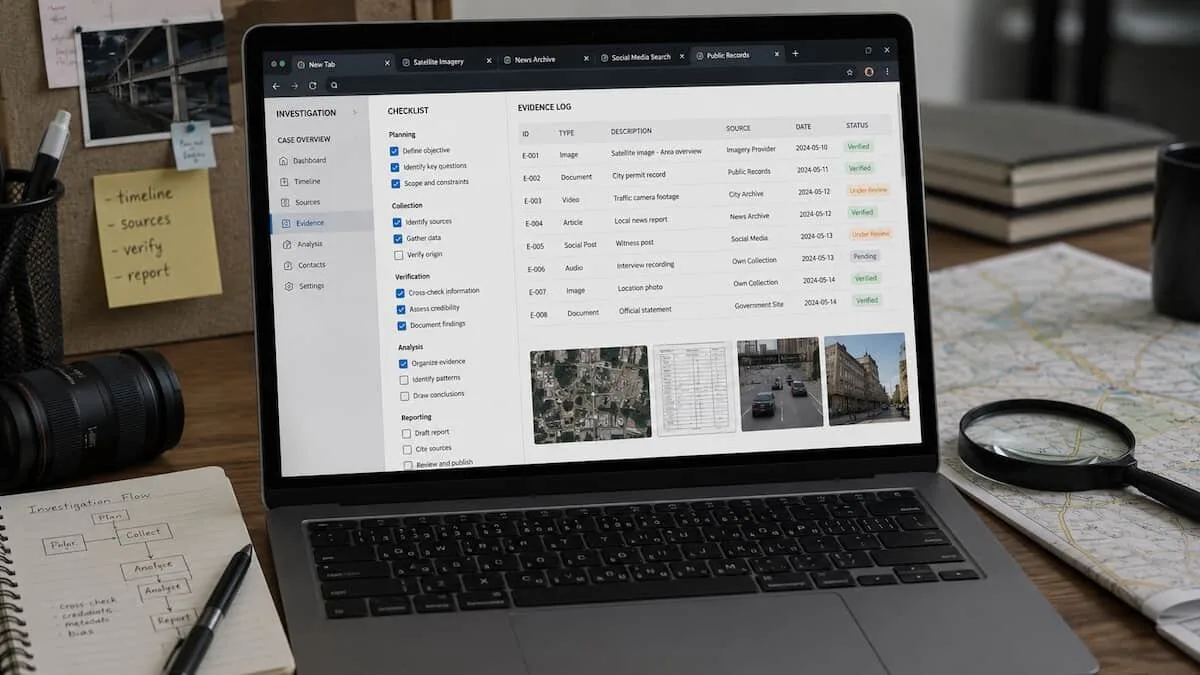
Use a simple table:
| Finding | Source | Date checked | Supports | Confidence | Open question |
|---|---|---|---|---|---|
| The domain existed on a specific date | Archived page | 19 June 2026 | Site timeline | Medium | Who controlled it then? |
| The username appears on two platforms | Platform pages | 19 June 2026 | Possible account link | Low | Is it the same person or a common handle? |
| The image matches a location | Map and visual comparison | 19 June 2026 | Possible geolocation | Medium | Can another landmark confirm it? |
AI can help turn messy notes into this table, but only if you give it your actual notes.
Do not ask it to build the table from memory or from a broad prompt. Give it the source titles, URLs, dates checked, and what each source actually showed.
Then ask:
Organize these notes into an evidence table. Do not add new facts. Separate confirmed facts, plausible inferences, and open questions.
This is one of the safest and most useful AI tasks in OSINT.
8. What Are the Legal and Ethical Boundaries?
AI can make invasive work feel abstract.
Do not let it.
If the investigation involves a private person, a vulnerable individual, a minor, a victim, a witness, a doxxing risk, a private address, medical information, financial data, or account access, the threshold must be higher.
Ask:
Is this information public, relevant, necessary, and proportionate? Could publishing it expose someone to harm? Can the same point be made without naming, locating, or exposing the person? Am I verifying a public-interest claim or satisfying curiosity?
For ProjectOSINT, the correct line is defensive, educational, and legal. The goal is to teach method, verification, and risk awareness. It is not to enable harassment, intrusion, stalking, or unnecessary exposure of private individuals.
AI should be used to reduce risk, not expand it.
9. What Should the Final Output Say?
When you write the final analysis, preserve the uncertainty.
Use:
- “The available public records show…”
- “The archived page indicates…”
- “The username appears on…”
- “This supports the possibility that…”
- “This does not prove…”
- “I could not independently verify…”
- “A stronger conclusion would require…”
Avoid:
- “This proves” when it only suggests;
- “obviously”;
- “clearly linked” without exact identifiers;
- “confirmed” without a source;
- “AI found” as evidence;
- “the person behind this is…” unless the evidence standard is very high.
The final output should not hide the limits. It should make them readable.
That is part of the value.
The AI-Assisted OSINT Checklist
Before using AI:
- What exactly am I trying to verify?
- What are the separate claims inside the question?
- What type of source would support each claim?
- Which facts must be checked outside AI?
- What legal or ethical risks exist?
While using AI:
- Am I asking AI to structure the work, or to decide what is true?
- Did I provide the sources and notes, or am I asking the model to fill gaps?
- Did AI add any facts that were not in my material?
- Did it remove uncertainty from the original evidence?
- Did it merge separate claims into one conclusion?
After using AI:
- Can I open and document the original sources?
- Are confirmed facts, plausible inferences, and unverified leads separated?
- Is every important date, name, location, domain, quote, and relationship checked?
- Are weak signals clearly labeled?
- Have I recorded what remains unknown?
The Real Test
The test of an AI-assisted OSINT workflow is not whether the output looks professional.
The test is whether another person can follow your evidence chain.
If they can see what you asked, what you checked, what you confirmed, what you rejected, and what you still do not know, AI has helped the investigation.
If they can only see a polished answer, the workflow is weak.
OSINT does not become stronger because AI makes it faster.
It becomes stronger when AI helps you ask better questions, document better evidence, and stop before a weak inference becomes a false conclusion.
Project Osint
Join the community