
A three-person research team building a document-classification pipeline on DeepSeek’s API had modeled their monthly compute cost down to the dollar. The whole business case rested on one number: $0.14 per million input tokens. On August 6, 2026, that number stopped being reliable. DeepSeek posted a notice on its developer platform warning that API prices were going up “by a relatively large margin,” without saying by how much or when. Anyone who had built a budget, a client quote, or a product margin on DeepSeek’s rock-bottom rates was left checking a page that no longer told them what they needed to know.
This is not a story about DeepSeek alone. It is a reminder that “cheap” AI pricing is a snapshot, not a promise, and that teams relying on any single vendor’s API rate card need a way to notice when the ground shifts.
Why DeepSeek Was the Cheap Option
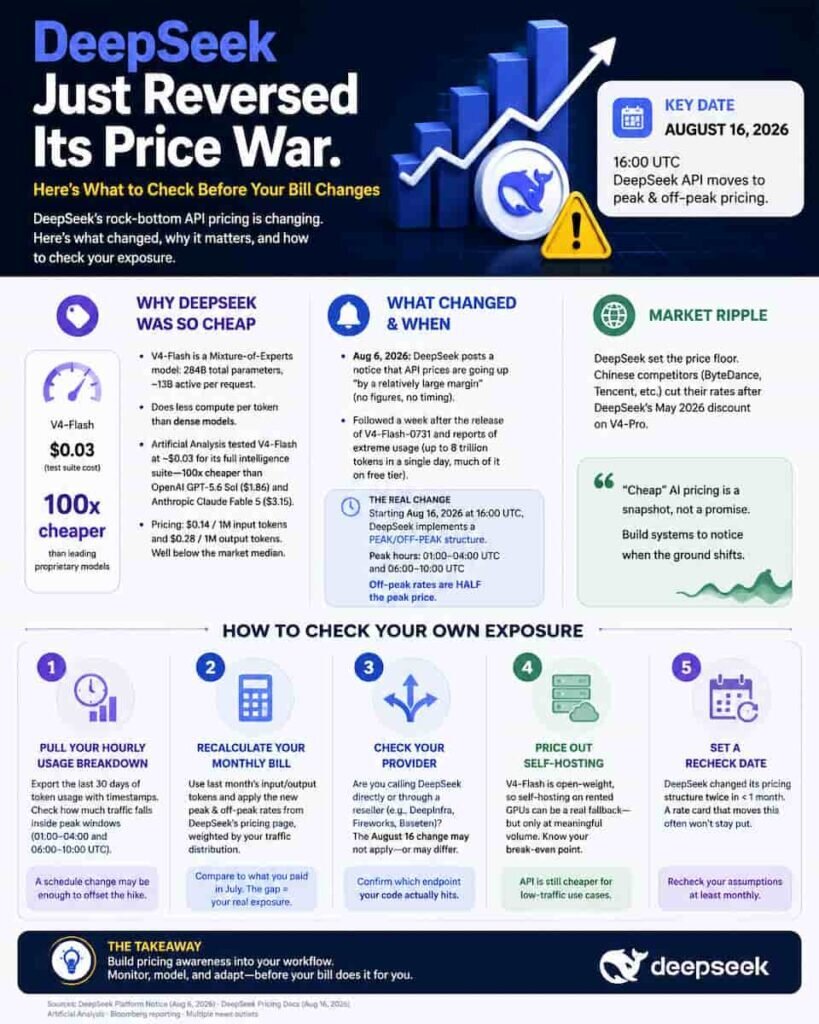
DeepSeek’s V4-Flash model became a reference point for low-cost inference because of how it is built, not because of a temporary promotion. It is a mixture-of-experts model with 284 billion total parameters but only about 13 billion active per request, which means it does less computational work per token than a dense model of comparable capability. Independent testing by Artificial Analysis, a research firm that benchmarks AI models on cost and performance, found that running its full intelligence test suite on V4-Flash cost roughly three cents. The same suite cost $1.86 on OpenAI’s GPT-5.6 Sol and $3.15 on Anthropic’s Claude Fable 5 — DeepSeek came in more than a hundred times cheaper on that specific measure. On paper pricing, V4-Flash listed at $0.14 per million input tokens and $0.28 per million output tokens, well under the median for comparable open-weight models.
That price floor did not stay isolated to DeepSeek. Chinese competitors including ByteDance and Tencent cut their own rates after DeepSeek introduced a separate discount on its V4-Pro model in May 2026. A low sticker price from one lab can move an entire regional market, which is exactly what made the August reversal notable: the company that had been setting the floor announced it was walking that floor back up.
What Actually Changed, and When
DeepSeek’s August 6 notice gave no figures. What followed, over the next several days, filled in some of the gaps. Reporting attributed to Bloomberg and confirmed by multiple outlets noted the warning came roughly a week after DeepSeek pushed a new lightweight release, V4-Flash-0731, into general availability, and amid reports of extreme daily traffic — one account put a single day’s V4-Flash usage at 8 trillion tokens, a large share of it on free-tier access. Whether the hike is a response to that surge, to underlying compute costs, or to a broader shift away from loss-leading pricing is not something DeepSeek has stated directly; treat any single explanation offered by analysts as informed speculation, not confirmed motive.
DeepSeek’s own documentation now shows the concrete change: starting at 16:00 UTC on August 16, 2026, the API moves to a peak and off-peak pricing structure, with peak hours set at 01:00–04:00 and 06:00–10:00 UTC and off-peak rates set at half the peak price. That is a real, dated, sourced figure — distinct from the vaguer “significant increase” language in the original notice, and worth checking directly on DeepSeek’s pricing page rather than assuming last month’s number still applies.
How to Check Your Own Exposure
If you or your organization call the DeepSeek API — directly, through an OpenCode-style tool, or through a third-party host — this is a workflow for finding out what changes for you, rather than waiting to see it on an invoice.
- Pull your current usage breakdown by hour. Most API dashboards, including DeepSeek’s, log token counts with timestamps. Export the last 30 days and check how much of your traffic falls inside the new peak windows (01:00–04:00 and 06:00–10:00 UTC). A batch job scheduled at 3:00 UTC now costs twice what the same job costs at 14:00 UTC. This is the single most actionable number in the whole story: a scheduling change, not a vendor switch, may be enough to offset the hike.
- Recalculate your monthly bill against the new rate card, not the old one. Take last month’s input/output token totals and multiply by the peak and off-peak rates published on DeepSeek’s own pricing documentation, weighted by how much of your traffic falls into each window. Compare that figure to what you actually paid in July. The gap is your real exposure — a number, not a headline.
- Check whether you’re calling DeepSeek directly or through a reseller. Because DeepSeek’s models are open-weight, several third-party hosts — DeepInfra, Fireworks, Baseten, and others — offer V4-Flash at their own rates, which do not automatically follow DeepSeek’s peak/off-peak schedule. If your integration goes through one of these providers, the August 16 change may not apply to you at all, or may apply on a different timeline. Confirm which endpoint your code actually hits before assuming the news applies to your bill.
- Price out self-hosting as a real fallback, not a theoretical one. Because V4-Flash’s weights are published, running it on rented GPU capacity is a genuine alternative if API costs rise past what your workload can absorb. This only makes sense at meaningful volume — for low-traffic use cases, the API remains cheaper than provisioning your own hardware — so this step is about knowing the break-even point, not about switching by default.
- Set a recheck date, not a one-time check. DeepSeek has changed its pricing structure twice in under a month — a peak/off-peak scheme floated in late June, and this August notice. A rate card that changed twice in four weeks is not a stable input for a yearly budget. Put a recurring 30-day reminder to re-pull the official pricing page rather than relying on cached knowledge from this article or any other.
A common mistake here is treating the August 6 warning itself as the final price, and re-pricing a whole project around a number DeepSeek never actually published. The warning was a signal to expect change, not a rate card. The rate card came ten days later, and it applies only to time-of-day billing — it says nothing about whether DeepSeek will make further changes to the base rate itself.
Why This Matters Beyond DeepSeek
For individual developers and small teams, the practical lesson is that per-token pricing from any provider, cheap or not, is a variable in a live market, not a fixed input. For journalists and communicators covering AI economics, the DeepSeek case is a useful example of how “prices are falling” and “prices are rising” can both be true stories about the same company within a single month, depending on which week you check. For organizations building OSINT or research tooling on low-cost open-weight models, the open-weight status itself is the real insurance policy: unlike a closed API, a model you can host yourself does not disappear or reprice without your consent, even if the vendor’s own service does.
The bigger pattern is a market correction, not a betrayal. DeepSeek priced aggressively to win share, and now needs revenue to match its stated infrastructure plans, including gigawatt-scale compute buildouts already underway. Cheap AI got teams used to a price point that was never guaranteed to last. The organizations least affected by August 16 will be the ones that already know exactly which hours their traffic runs in, and exactly what their bill looks like under the new numbers instead of the old ones.
Project Osint
Join the community