
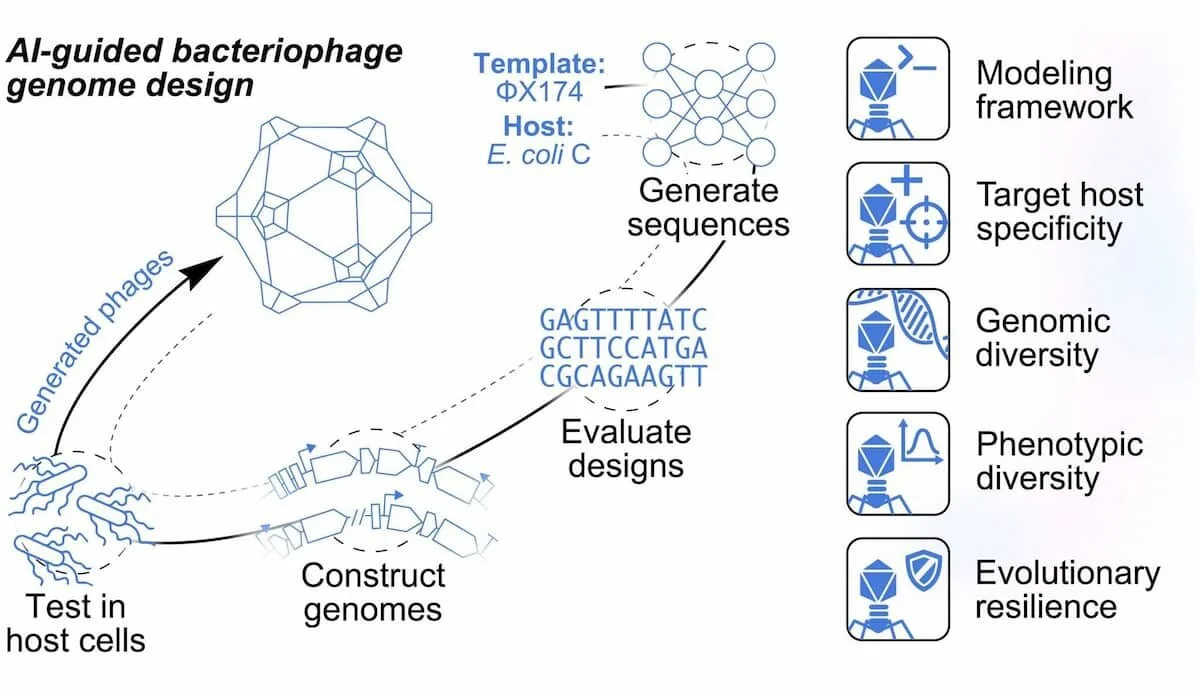

A generative model producing a plausible DNA sequence is one thing. Producing a complete viral genome that functions as an interconnected biological system is another.
Research teams from Stanford University and the Arc Institute have demonstrated the generative design of functional bacteriophage genomes using the specialised genomic language models Evo 1 and Evo 2. The result marks a shift in what genomic AI can be asked to design: not an isolated sequence or individual genetic component, but an entire genome whose parts have to work together.
For AI research, the distinction is technical. For biosafety, it is structural. If biological design increasingly begins as a digital object generated by a model, verification can no longer focus only on individual sequences or known dangerous components. The relationships between those components also matter.
The case: from sequence generation to complete genomes
The Evo models were pretrained on genomic data and subsequently optimised using natural Microviridae genomes. According to the source material, the experiments showed that the system could generate complex combinations of genetic modifications rather than simply reproduce known natural variants.
That difference is central to the case.
A viral genome does not function as a collection of independent instructions. Changes in one part can alter what another part does. The research illustrates this through Evo-Φ36, where the function of an individual viral gene showed a strong dependence on its wider genomic context.
This makes the result more consequential than the ability to generate biologically plausible strings of DNA. The model is operating on relationships across a genome.
The researchers describe the generative design of complete bacteriophage genomes as a milestone in the ability to construct biological systems. The evidence provided here concerns bacteriophages — viruses that infect bacteria — and should not be expanded into claims about successful AI generation of functional human pathogens. The supplied material does not support that conclusion.
That boundary is essential when interpreting the case.
What the experiment actually demonstrates
The strongest supported claim is also the most precise one: specialised genomic language models generated functional bacteriophage genomes containing combinations of changes different from known natural variants.
This establishes a capability in generative biological design. It does not establish that the same procedure can currently produce dangerous human viruses.
The distinction matters because several very different stages are easily collapsed into the phrase “AI-designed virus”: generating a digital genome, assessing whether its components appear biologically coherent, physically constructing that genome, and demonstrating that the resulting biological system functions.
The experiment crosses an important part of that chain for bacteriophages. It does not erase the remaining technical and experimental barriers described by the researchers.
The source material states that adapting Evo 2 to dangerous human viruses would require large quantities of relevant data, substantial computational and experimental resources, specialised methods and expert knowledge. Those constraints are part of the evidence, not qualifications to be discarded when discussing the risk.
Why genomic context changes the verification problem
Evo-Φ36 exposes a particularly useful lesson: assessing a genetic element in isolation can miss what that element does inside a different genomic architecture.
This creates a verification problem.
Many security controls are easier to conceptualise when the object being examined is already known: a recognised pathogen, a known sequence or another previously identified biological risk. Generative design introduces the possibility of novel combinations whose relevant properties emerge from relationships across the genome.
The researchers therefore point toward a broader form of screening: analysing complete genomes rather than relying exclusively on individual components. The supplied material also indicates that genomic language models themselves could eventually contribute to that screening process.
This produces an unusual security relationship. The same class of computational system that expands biological design capabilities may also become part of the infrastructure used to evaluate generated designs.
The critical point is not that AI automatically defeats existing biosafety controls. The case shows why controls built around recognition of known biological objects may need to evolve when generation increasingly operates at genome scale.
The digital-to-physical boundary
The most useful security perspective in this case lies between computation and biology.
A generated genome remains information until it enters a process capable of turning that information into a physical biological object. The researchers identify this boundary as an area where protective controls can be applied.
That changes where analysts should look when assessing future risks from generative biology.
The model is only one component. Relevant capabilities also include access to genomic data, computational infrastructure, specialised expertise, experimental resources and facilities capable of biological implementation. The source explicitly identifies these requirements when discussing the theoretical possibility of adapting genomic models to dangerous human viruses.
This makes capability assessment more informative than treating model availability alone as evidence of an operational biological threat.
A defensible analysis should therefore separate at least three questions: what can be generated digitally, what can be constructed physically, and what has actually been demonstrated to function.
Confusing those levels produces both exaggeration and blind spots.
Biosafety without speculative escalation
The source material raises severe theoretical scenarios, including modified human viruses and pathogens with increased pandemic potential. It also argues that biosafety systems need to develop alongside generative biology.
Those scenarios belong in the analysis because the researchers themselves discuss malicious-use implications. They should not be reported as demonstrated capabilities.
The evidence supplied does not show that Evo 2 has generated a pandemic pathogen. Nor does it demonstrate that access to the model is sufficient to create one. The requirements described in the material point in the opposite direction: substantial data, computing, experimental infrastructure, methods and expertise remain necessary.
The security issue is therefore prospective rather than hypothetical in the trivial sense. A relevant technical capability has been demonstrated in one biological domain, while the researchers identify conditions under which its extension could create more serious risks.
That is enough to justify scrutiny without converting a bacteriophage experiment into a claim about an imminent artificial pandemic.
What this case changes
The most important result is not that AI can “invent viruses.” That formulation removes precisely the distinctions needed to understand the research.
The case demonstrates that genomic language models can participate in the design of complete functional bacteriophage genomes whose behaviour depends on interactions across the genome. That pushes the analytical unit from individual sequences toward biological systems.
It also shifts part of the biosafety problem upstream.
If increasingly complex biological objects can originate as generated digital designs, security cannot begin only after physical construction. Screening, capability assessment and verification have to consider what happens before a genome reaches the laboratory, while retaining a clear distinction between a computational design and a demonstrated biological threat.
For investigators and analysts following generative biology, that distinction provides a durable criterion: do not ask only what a model generated. Ask what was experimentally demonstrated, which dependencies were required to make it functional, what remains theoretical, and where the digital design can cross into physical implementation.
In this case, the verified achievement is already substantial. There is no need to make it larger than the evidence.
Evidence status
Demonstrated: generative design of functional bacteriophage genomes using specialised genomic language models, including genomes different from known natural variants.
Supported by the case: genome-wide context can affect the function of individual viral genes, making whole-genome relationships relevant to biological design and screening.
Prospective: genomic models may have applications in areas such as viral-vector optimisation and therapeutic bacteriophage design.
Theoretical risk: further training on dangerous human-virus data and malicious biological design. The supplied material states that such developments would currently require substantial data, computing, experimental resources, specialised methods and expertise.
Not demonstrated by the supplied evidence: successful AI generation of a functional pandemic human pathogen or an artificial pandemic.
Project Osint
Join the community


