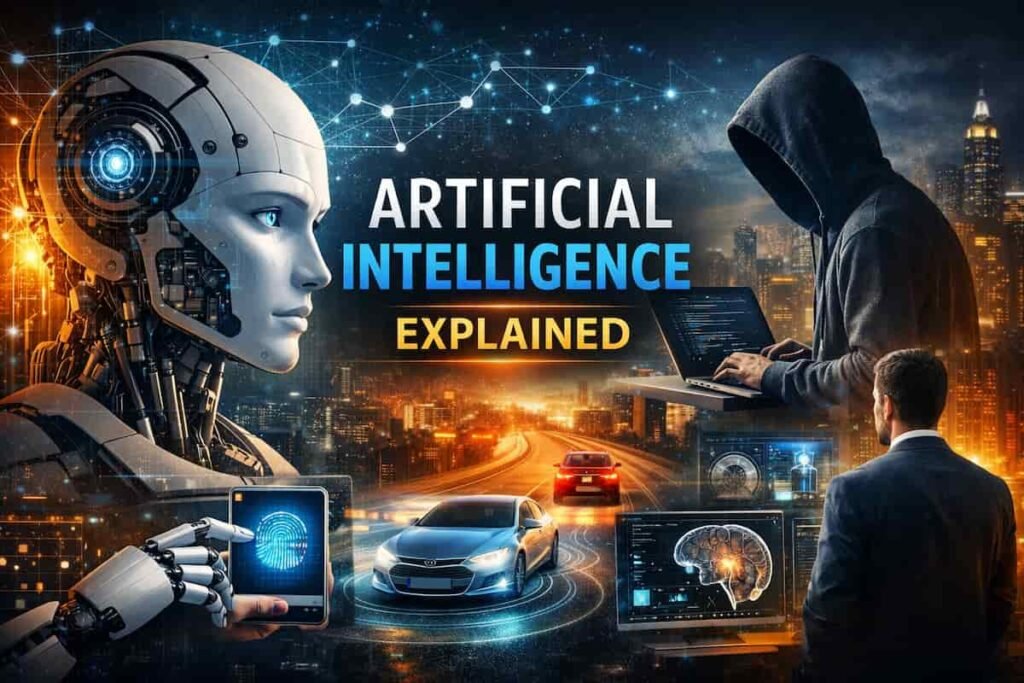
What does Artificial Intelligence really mean today?
Artificial intelligence has moved from research labs into everyday life.
A few years ago, the topic mostly appeared in academic papers or science fiction. Today it writes emails, recommends films, detects fraud and helps doctors analyze medical images.
Yet one question keeps surfacing in search engines and conversations:
What does artificial intelligence actually mean?
The answer is less mysterious than it sounds. AI refers to computer systems capable of performing tasks normally associated with human reasoning. That includes pattern recognition, language processing, prediction and decision-making.
The current wave of interest comes from a specific branch of AI: generative AI, the family of models capable of producing text, images, code and audio.
These systems are not “thinking machines.”
They detect statistical patterns across enormous datasets and generate new outputs based on probability.
Still, their impact on work, security and information flows is already tangible.
What is Artificial Intelligence in simple words?
Artificial intelligence describes software that learns from data and improves its performance over time.
Instead of following rigid instructions, the system analyzes large quantities of information and identifies patterns.
Those patterns then guide future predictions.
A simple illustration helps.
Spam filters in email services learn which messages resemble previous spam campaigns. Over time they refine their classification accuracy.
The same principle scales upward in more complex domains.
Voice assistants interpret spoken language. Recommendation systems study user behavior. Fraud detection systems flag unusual transactions.
AI does not replace human reasoning entirely. It automates parts of it.
That distinction matters when discussing the future of work and decision-making.
The four main types of Artificial Intelligence
Researchers often classify AI into four conceptual categories.
Reactive machines
These systems operate strictly in the present moment. They respond to input but do not store memory.
A famous example often cited in AI history is IBM’s Deep Blue chess program.
Limited memory systems
Most practical AI applications belong to this category.
They analyze historical data and improve their predictions based on past observations. Autonomous driving algorithms fall into this group.
Theory of mind AI
This category refers to hypothetical systems capable of understanding human emotions and intentions.
Researchers explore the idea, but practical implementations remain limited.
Artificial general intelligence
Often abbreviated as AGI, this concept describes machines capable of performing any intellectual task a human can handle.
AGI remains a theoretical milestone rather than an operational technology.
Most systems used today fall into the second category: limited memory AI.
Generative AI: the technology behind the current boom
The surge of interest in artificial intelligence since 2022 revolves around generative models.
These systems rely on neural networks trained on massive datasets. They learn statistical relationships between words, images or sound patterns.
Large language models generate text. Image diffusion models produce visual material.
The mechanism relies on probability.
A generative model predicts the next element in a sequence. When repeated thousands of times, the system produces entire paragraphs, pictures or lines of code.
Examples of generative AI applications
- automated content drafting
- software code generation
- customer support chat systems
- synthetic images for design or marketing
- language translation and summarization
Each application reduces the time required for routine tasks.
Yet these systems also raise concerns around reliability, copyright and misinformation.
Artificial Intelligence in everyday life
Many people interact with AI daily without noticing.
The technology hides behind familiar services.
Search engines
Modern search engines rely heavily on machine learning to interpret queries and rank results.
Social media algorithms
Platforms analyze user interactions to determine which posts appear in the feed.
Voice assistants
Speech recognition and language understanding enable conversational interfaces.
Fraud detection
Banks rely on machine learning models to detect suspicious transactions.
Healthcare diagnostics
Medical imaging software assists doctors in identifying patterns in scans.
These applications illustrate how AI has gradually blended into digital infrastructure.
Artificial Intelligence and the future of work
Few topics generate as much debate as the relationship between AI and employment.
Automation has always changed labor markets.
Mechanization reshaped agriculture. Computers transformed manufacturing and office work. Artificial intelligence may represent another shift in that long historical cycle.
Certain roles involve repetitive tasks that algorithms can perform faster.
Examples include:
- basic data entry
- routine customer service interactions
- simple document analysis
- repetitive coding tasks
Yet new roles also emerge.
Machine learning engineers, data scientists and AI governance specialists have become highly sought-after positions.
The labor market rarely disappears. It reorganizes.
The real challenge lies in managing transitions between declining roles and emerging professions.
The risks and limits of Artificial Intelligence
The rise of AI also introduces serious concerns.
Bias in training data
AI systems reflect patterns in the data used during training. If historical datasets contain bias, the model can reproduce it.
Misinformation at scale
Generative AI systems can produce large volumes of synthetic content. That ability raises questions about authenticity online.
Security implications
Cybercriminal groups experiment with AI-generated phishing campaigns and automated vulnerability discovery.
Overreliance on automated decisions
When organizations trust algorithms without human oversight, errors can spread quickly.
AI systems excel at pattern detection.
They do not possess contextual awareness or ethical judgment.
Human supervision remains essential.
Artificial Intelligence and cybersecurity
Security professionals increasingly use AI to detect anomalies in digital networks.
Machine learning models can analyze large streams of system activity and flag unusual behavior.
The same technology also appears in offensive contexts.
Attackers experiment with AI-generated malware variations and automated reconnaissance techniques.
That dynamic creates a technological arms race.
Security teams must learn to interpret algorithmic signals rather than relying solely on manual analysis.
AI will not eliminate cyber threats.
It will change their scale and speed.
Where Artificial Intelligence is heading next
Predicting technological trajectories always carries uncertainty.
Still, several trends already appear clear.
AI models are becoming more multimodal. Future systems will combine text, images, audio and video within a single framework.
Hardware advances continue to accelerate training processes.
Regulatory frameworks are also evolving. Governments are drafting rules around transparency, accountability and data governance.
The debate no longer focuses on whether AI will influence society.
The discussion now concerns how that influence should be managed.
Artificial Intelligence: the real question is not the technology
The core issue surrounding artificial intelligence rarely concerns the algorithms themselves.
The real question involves how humans choose to deploy them.
AI can automate routine analysis, accelerate research and uncover patterns that might escape human observation.
At the same time, the same tools can amplify misinformation or automate malicious activity.
Technology rarely determines outcomes on its own.
Human decisions shape the direction.
Want to explore Artificial Intelligence and OSINT further?
If AI already influences investigations, cybersecurity and digital research, understanding its mechanics becomes essential.
Join the community:
Newsletter
https://coondivido.substack.com/s/osint-ai
Telegram
https://t.me/osintaipertutti
https://t.me/osintprojectgroup