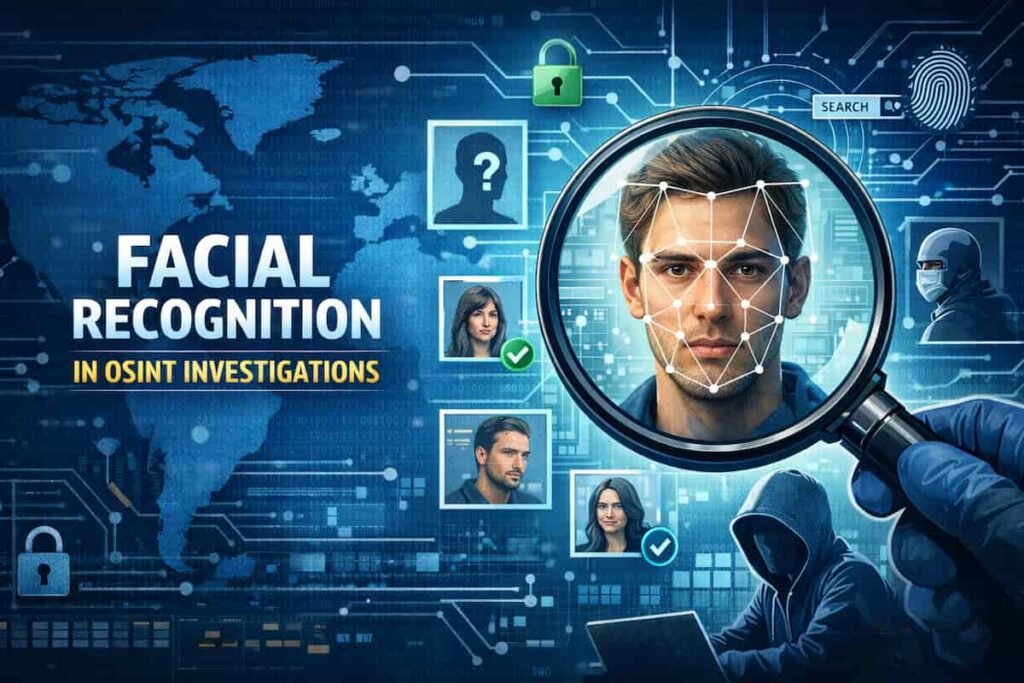
Introduction: when a face becomes evidence
A username can change.
An email can disappear.
A face usually doesn’t.
That simple fact explains why facial recognition in OSINT has moved from a niche technique to a core investigative asset. As images flood social platforms, forums, and data leaks, analysts increasingly rely on faces to reconnect fragmented digital identities.
This shift matters today more than ever. Online anonymity has become easier to manufacture, while visual traces remain stubbornly persistent. For investigators, that tension creates opportunity.
What facial recognition means in OSINT
Facial recognition within OSINT is not about surveillance cameras or state databases. It works strictly on publicly available images: profile photos, tagged pictures, screenshots, livestream captures, archived media.
Unlike simple reverse image search, facial recognition focuses on biometric patterns, not pixels. A cropped selfie, a filtered avatar, or a low-resolution screenshot can still reveal the same person across unrelated platforms.
This capability changes how identity verification works in open-source investigations.
How facial recognition fits into OSINT workflows
Traditional OSINT starts with text-based clues: usernames, phone numbers, domains. Those signals remain useful, but they break down when aliases multiply.
Facial recognition adds a different anchor point.
Investigators use it to:
- Detect the same person behind multiple social accounts
- Expose aliases created with different names
- Verify identities tied to fraud, impersonation, or extremist activity
- Map relationships through shared images and co-appearances
A single face can reconnect scattered digital traces that text alone fails to link.
From image to intelligence: the investigative process
Step 1
Visual Input
Step 2
Facial Detection
Step 3
Cross-Platform Matching
Step 4
Analytical Validation
Cybercrime and darknet investigations
Avatars, leaked ID photos, marketplace images, livestream captures. Visual leaks happen more often than threat actors admit. Facial recognition links those fragments back to real-world identities.
Due diligence and compliance checks
When documents conflict or look forged, biometric signals add another layer of confidence. This matters in executive screening, insider risk reviews, and background investigations.
Legal boundaries and responsible use
Facial recognition in OSINT operates under strict constraints.
Only publicly accessible data qualifies. No scraping behind logins. No private databases. No covert collection.
Equally important is proportionality. Analysts must justify why biometric analysis is necessary and document every step. Transparent reasoning protects both investigations and investigators.
Handled carelessly, facial recognition becomes a liability. Used responsibly, it becomes defensible evidence.
What comes next: beyond the face
Facial recognition no longer stands alone. It is merging with other biometric signals: gait analysis, voice patterns, behavioral markers, media forensics.
This convergence creates multi-layer identity intelligence, harder to deceive and easier to validate. Deepfake detection already plays a role, filtering manipulated images before analysis begins.
The future of OSINT belongs to correlation, not single signals.
Why this capability matters now
Digital identities grow more fragmented every year. Faces remain one of the few stable anchors left.
Facial recognition in OSINT allows investigators to cut through noise, expose deception, and rebuild trust in open-source findings. When combined with careful analysis and legal discipline, it becomes one of the most reliable tools available.
Want to explore how facial recognition fits into real OSINT workflows?
Join the community and follow practical investigations, tools, and case studies.
Newsletter: https://coondivido.substack.com/
Telegram: https://t.me/osintaipertutti
Telegram group: https://t.me/osintprojectgroup