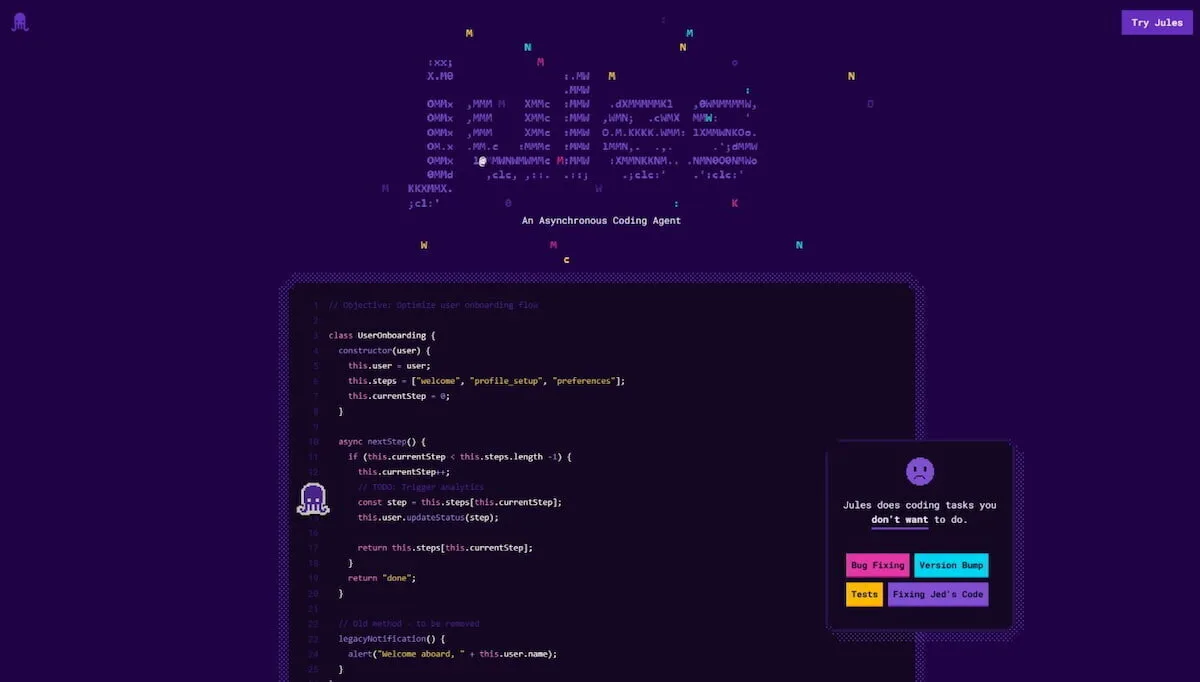

Google has escalated the battle for AI-powered developer tools with the official launch of Jules Tools, a command-line interface and public API that embed its autonomous coding agent directly into developer workflows. The move, announced Thursday, represents Google’s most aggressive challenge yet to Microsoft’s GitHub Copilot, which dominates the sector with more than 20 million users and 77,000 enterprise customers.
By transforming its web-based coding agent into a native workflow assistant, Google is betting that developers want less context-switching and more seamless automation. “We want to reduce as much context switching as possible for developers,” said Kathy Korevec, product director at Google Labs.
Strategic differentiation in a crowded market
Unlike the existing Gemini CLI, which requires iterative collaboration, Jules Tools is designed for delegated programming tasks. Developers can assign entire jobs, and the agent independently executes plans on cloud-based virtual machines, then returns with pull requests and even audio summaries.
This shift positions Jules as more than a co-pilot—it’s an autonomous agent that can take over routine development work, freeing engineers to focus on higher-level tasks.
Key features include:
- Command-line integration: Developers can launch Jules directly from the terminal with commands like
jules remote new --repo. - Public API: Enables integrations with IDEs such as VSCode, CI/CD systems, and custom workflows.
- Multi-platform support: From Slack to GitHub pipelines, Jules can embed into familiar developer environments.
Market context and competitive pressure
Google’s timing reflects intensifying competition. According to Gartner, 90% of enterprise software engineers will use AI coding assistants by 2028, up from less than 14% in early 2024. The surge has drawn heavyweights: Amazon’s CodeWhisperer, Anthropic’s Claude Code, and startups like Cursor are all competing for market share.
Despite launching publicly in May, Jules remains in catch-up mode. It has supported “thousands” of developers, with over 140,000 code updates processed, but these figures pale compared to Copilot’s massive adoption within Microsoft’s GitHub ecosystem.
Pricing and adoption strategy
Google rolled Jules out of beta in August with a tiered pricing model:
- Free plan: 15 tasks per day.
- Google AI Pro ($19.99/month): 5x higher task limits.
- Google AI Ultra ($124.99/month): 20x higher capacity, designed for enterprise multi-agent workflows.
The model aims to attract both individual developers and enterprise teams, mirroring SaaS adoption patterns in the developer tools market.
Google’s Jules Tools represents a strategic pivot: from being a supplementary coding companion to a fully autonomous agent integrated directly into developer pipelines. Its CLI-first approach sets it apart from GitHub Copilot’s IDE-centric model, while its API ambitions signal a push for ecosystem-wide adoption.
The question remains whether Jules can overcome GitHub Copilot’s first-mover advantage and Microsoft’s entrenched enterprise relationships. For now, Google’s bet is clear: AI coding assistants are not just sidekicks—they’re becoming co-workers.