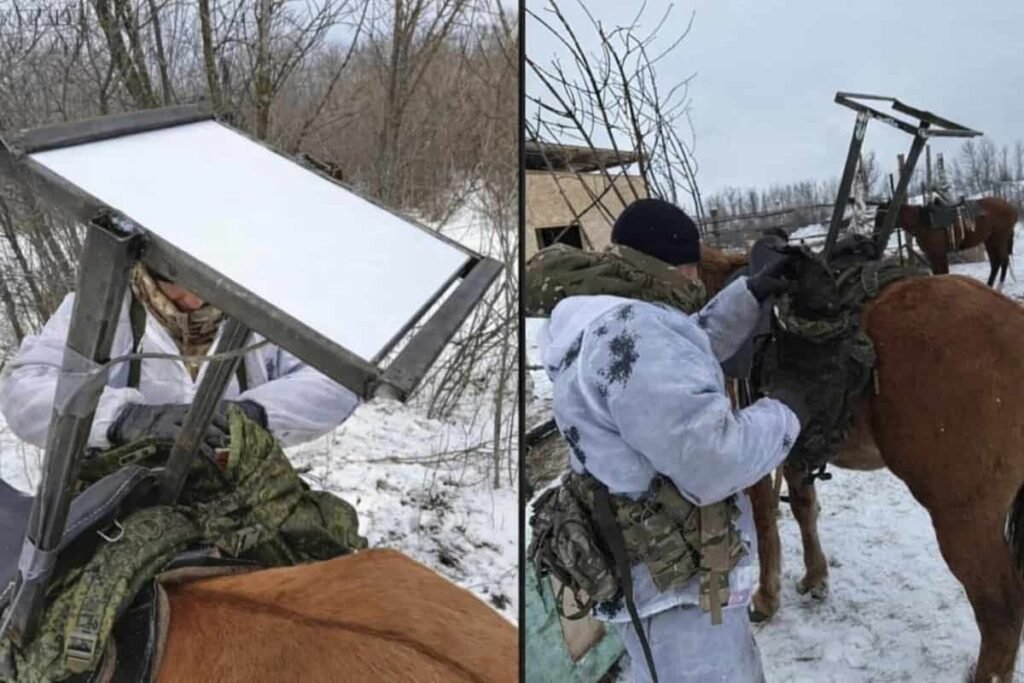
Photos and short videos circulating online in early January show a scene that feels out of step with modern warfare. Russian soldiers ride horses across snowy terrain. Fixed to improvised frames on the animals’ backs sit flat satellite terminals and small camera systems. The images suggest an attempt to merge 19th-century mobility with 21st-century connectivity.
According to multiple open-source investigators who shared the material, Russian units appear to have begun equipping horse-mounted troops with satellite internet gear. The setup resembles commercially available flat-panel terminals commonly used for broadband connectivity in remote areas.
What the Images Show
The footage shows horses fitted with rigid metal frames supporting rectangular satellite panels. In some cases, additional equipment that looks like cameras is attached to the same structure. Soldiers are seen adjusting or securing the mounts while the animals stand still.
There is no indication that the platforms are intended for direct combat use. Analysts reviewing the material note that the configuration aligns more closely with communications or situational awareness tasks than with weapons deployment.
Why Horses, Why Now
The appearance of cavalry units is not entirely new in the current conflict. Earlier material documented Russian troops using horses for transport in areas where vehicles were scarce or vulnerable. One such attempt to advance toward Ukrainian positions was detected from above and stopped by a drone strike before reaching its objective.
Subsequent reporting points to a broader pattern. In contested zones or regions with limited infrastructure, Russian frontline units have increasingly relied on animals to compensate for destroyed or unavailable vehicles. Horses do not require fuel, can move quietly, and are less constrained by damaged roads. Those traits are often cited by Russian military bloggers as advantages in terrain saturated with drones and artillery.
At the same time, animals offer no protection against aerial surveillance. Their slower pace and exposure leave riders vulnerable once spotted from the air.
A Sign of Logistical Strain
Training for horse-mounted assault teams reportedly began months earlier in parts of the occupied Donetsk region. The initiative has been linked to a commander within a Storm special unit of the 9th Brigade of the 51st Army, known by the callsign “Khan.”
Commentary from Russian sources frames the shift as a pragmatic adaptation. Armored vehicles and trucks have suffered heavy losses, and movement by road has become increasingly dangerous. Horses, in this context, are portrayed as a low-tech answer to high-precision threats.
The addition of satellite internet hardware adds another layer to that adaptation. Reliable connectivity can support coordination, navigation, and real-time awareness, even when conventional communications infrastructure is degraded.
An Unusual Hybrid
The image of a horse carrying a satellite terminal captures the contradictions of the current battlefield. Advanced sensors, drones, and precision strikes coexist with methods that predate mechanized warfare. The result is a hybrid approach driven less by doctrine than by necessity.
Whether these horse-mounted systems will prove effective remains unclear. What is evident from the available material is the degree to which equipment losses and logistical pressure are reshaping how Russian units move and communicate at the front.
The battlefield, it seems, has room for both satellites in orbit and hooves in the snow.