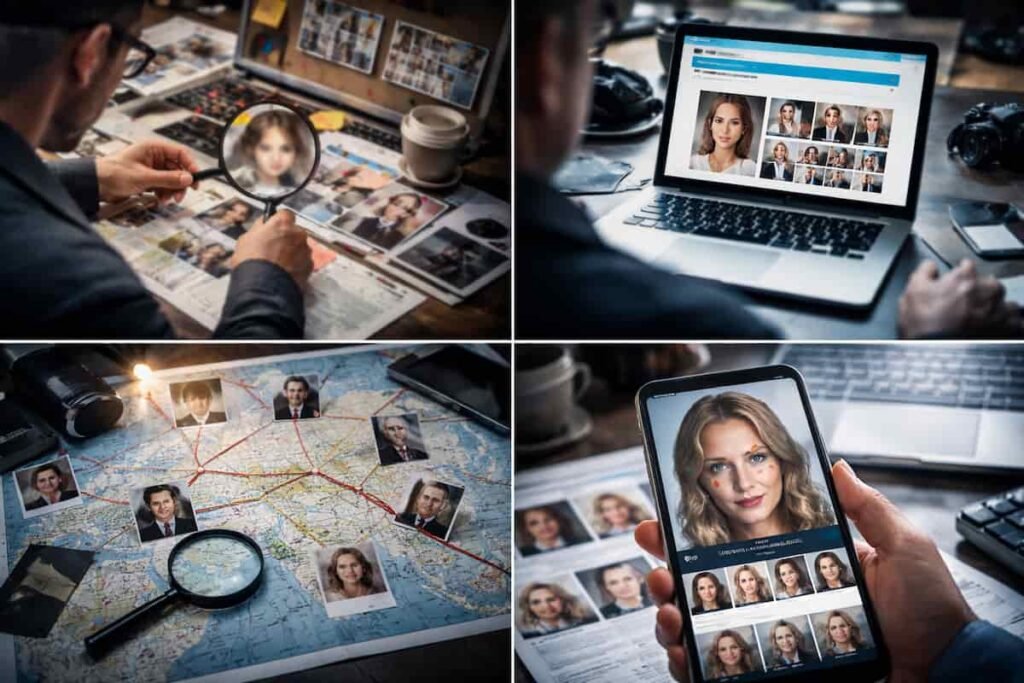
A faded photograph and a name almost erased
The photo was old.
Edges worn. Colors washed out. The face barely sharp enough to catch attention.
It surfaced during the reorganization of a local archive in northern England. A handwritten note on the back carried a name: Margaret Lewis. No date. No address. No further clues.
She had disappeared quietly in the early 1970s. No police report. No headlines. Just absence.
That image became the only trace left behind.
What followed was not luck. It was method.
And it proves a simple point: a single photograph, handled correctly, can reopen stories that time tried to close.
What it really means to search for a person using a photo
In OSINT, a photograph is never the answer.
It is a pivot point.
Searching for a person using an image means tracking where that visual identity intersects with the public web. Faces, backgrounds, formats, and reuse patterns all leave signals.
The objective is not recognition.
It is correlation.
Reverse image search: where every investigation begins
Reverse image search flips the logic of traditional queries.
Instead of asking who, you ask where.
Where has this image appeared?
Where has it been reused, cropped, altered, or embedded?
This shift changes the entire investigation.
Tools that matter when working from a photograph
Google Lens: precision over brute force
Google Lens works best when investigators stop using it broadly and start using it surgically.
Cropping matters. Isolating a face, a building, a sign, or even a piece of clothing often produces better results than uploading the full photo.
In the case of Margaret Lewis, background elements led to early matches long before facial similarities did.
PimEyes: when faces resurface over time
PimEyes focuses on facial geometry rather than metadata or context.
Its strength lies in persistence. Images that appear months later, under different names or profiles, often trigger alerts.
That makes it useful when a person has resurfaced quietly, without public attention.
RevEye: fast comparisons, early filtering
RevEye is not deep.
It is fast.
Right-click, search, compare engines. It helps eliminate false trails early and identify obvious reposts that can otherwise waste hours.
Investigators use it for triage, not conclusions.
FaceCheck.ID: faces across formats
FaceCheck.ID extends facial search beyond static images.
It scans thumbnails, video frames, and lesser-indexed sources. Similarity scores reduce guesswork and help assess whether a match deserves further scrutiny.
In many cases, video fragments reveal more than profile photos.
Why tools alone are never enough
Most failed photo-based investigations collapse for one reason: tool dependency.
Images speak through context. Tools only amplify what the investigator already notices.
How to read a photograph like an investigator
Metadata: useful when present, irrelevant when not
EXIF data can reveal date, device, and sometimes location. When it exists, it saves time. When it doesn’t, experienced analysts move on without hesitation.
Absence of metadata is not a dead end.
Background analysis: the real storyteller
Landscapes, road markings, shop signs, vegetation, architecture.
These details narrow geography faster than facial recognition.
In Margaret’s case, a barely visible storefront sign pointed to a town hundreds of miles from where she was last seen.
That shift changed everything.
Image dimensions and platform habits
Image size often betrays origin.
Square crops suggest profile use.
Wide banners hint at professional networks.
Compressed vertical frames point to mobile uploads.
Platform behavior leaves fingerprints.
Legal and ethical boundaries still apply
OSINT relies on publicly accessible data.
That does not justify harassment, exposure, or misuse.
Ethical investigations respect:
- privacy limits
- platform rules
- personal safety
Finding a person does not grant ownership over their story.
What actually makes photo-based OSINT effective
Not artificial intelligence.
Not automation.
Not volume.
What works is sequence.
Observation.
Hypothesis.
Verification.
Connection.
A photograph is never the conclusion.
It is the first hinge.
Take the next step
If this article changed how you look at images, you’re already thinking differently.
To keep sharpening your OSINT skills and work with real cases, methods, and tools:
- Newsletter: https://coondivido.substack.com/
- Telegram: https://t.me/osintaipertutti
- Telegram: https://t.me/osintprojectgroup
The web keeps traces.
Only trained eyes know where to look.