AI writes well, but it writes “cold.” Generated texts often lack the grit, concreteness, and the subtle art of not over-explaining that define human prose. If you want your content to truly resonate with readers, you must learn to edit algorithmic output with a clinical eye.
Here are five fundamental pillars to transform a synthetic draft into high-impact writing.
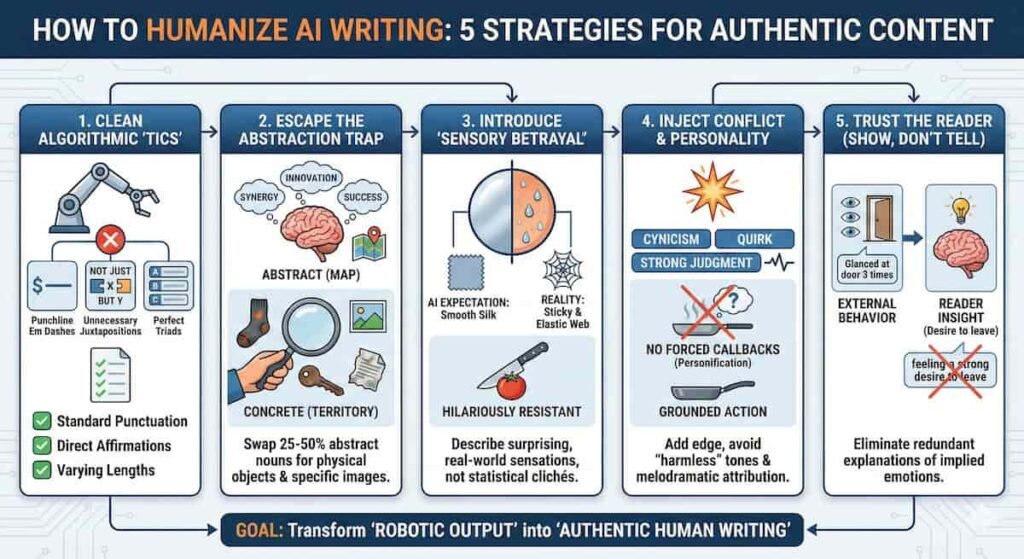
1. Cleaning Algorithmic “Tics”
AI has structural habits that betray it immediately. To “clean” the text, intervene on these three points:
- Goodbye to Punchline Em Dashes: Avoid using the em dash ($—$) to deliver a dramatic conclusion at the end of a sentence. Use standard punctuation or rewrite to create natural rhythm.
- Eliminate Unnecessary Juxtapositions: Structures like “It’s not just X, but Y” are often fillers. Remove the negation and dive directly into the main affirmation.
- Break Perfect Triads: AI loves lists of three items where the last one is the longest. Vary the number of items or convert the list into prose to avoid structural monotony.
2. From the Map to the Territory (Escaping Abstraction)
AI tends to use conceptual words because it lacks physical experience of the world. To make the text visual:
- Replace Abstract with Concrete: Swap 25% to 50% of abstract nouns for objects you can hold, smell, or draw.
- Use Specific Images: Instead of writing about “the horrors of war,” describe “a kid’s burnt socks lying in the road”. No paragraph should pass without at least one concrete image.
3. The Power of “Sensory Betrayal”
AI descriptions are often based on predictable statistical associations, such as “smooth silk”. Reality is more surprising:
- Surprise the Reader: Anyone who has walked into a web knows it is sticky and elastic, not just “fine”.
- Describe Real Sensations: Think of the “hilarious resistance” of a tomato when you try to cut it with a dull knife. These “dirty” details signal an authentic human point of view.
4. Inject Conflict and Personality
AI is often programmed to be excessively harmless, resulting in bland or sycophantic tones.
- Add “Edge”: A story without conflict is a sedative. Introduce an element of cynicism, a quirk, or a strong judgment to ignite the reader’s mind.
- Avoid Forced Callbacks: Do not attribute memory or agency to inanimate objects—like “a pan that remembers the last thing it burned”—unless you want to sound melodramatic. Keep it grounded: “He picked up the pan, still hot from the stove”.
5. Trust the Reader (Show, Don’t Tell)
A common AI mistake is explaining what the scene has already implied.
- Eliminate Redundant Explanations: If you write that a character “glanced at the door three times,” the reader understands they want to leave; do not add “feeling a strong desire to leave the room”.
- Replace Internal States with External Behavior: Instead of describing an intention (“He wanted to leave her”), describe the physical action (“He glanced at the door and back at her”). Let the reader have the reward of figuring it out.
In Summary: Humanizing a text is not just about making it grammatically correct; it’s about restoring its “edges.” By applying these methodical corrections—or using a sequence that addresses each problem step-by-step—your content will stop sounding mass-produced and start truly speaking to people.
To keep sharpening your OSINT skills and work with real cases, methods, and tools:
- Newsletter: https://projectosint.substack.com/
- Telegram: https://t.me/osintprojectgroup