Is it possible for sixteen billion digital keys to the lives of half the global population to vanish into the hands of criminals simultaneously? This is not a dystopian movie plot but the reality of 2025’s massive credential exposure. In June of year, researchers identified thirty massive datasets containing billions of login credentials for giants like Google, Apple, and Facebook. These logs were not the result of a single hack but a systematic harvest by infostealer malware, proving that security perimeters no longer stop at the office wall. In an era where Intelligenza Artificiale fuels industrial-scale vulnerability scanning, mastering OSINT and Google Dorking is a survival skill. The ability to find what is public but unintended for viewing separates resilient organizations from those destined to be 2025’s next headline.
The Visible Invisible: Reconnaissance in the AI Era
Modern cybersecurity reveals a harsh truth: attackers aren’t breaking in; they are logging in using keys left under the digital mat. Recent data shows that 35.5% of breaches now involve third-party vendors, where criminals exploit partner credentials to bypass internal defenses. This tactical shift has made OSINT (Open Source Intelligence) the primary tool for mapping a target’s digital footprint before an assault.
Generative AI has acted as a force multiplier for social engineering. In 2025, approximately 16% of reported incidents involved attackers using AI to create hyper-realistic phishing and vishing lures. Criminals now use voice clones and deepfake videos to deceive executives into authorizing multimillion-dollar transfers. AI’s ability to analyze vast OSINT datasets allows for personalized attacks at an unimaginable scale, turning a simple username into a full psychological profile.
Global Data Breach Statistics and Costs
The financial impact of digital negligence has reached record highs. The United States leads the world with an average breach cost of $10.22 million. Even more concerning is the breach lifecycle: it takes an average of 194 days just to identify an intrusion. However, organizations utilizing threat intelligence identify dangers 28 days faster than the global average.
| 2025 Breach Metrics | Global Average / Statistic | Source |
| Mean Time to Identify | 194 days | |
| Mean Time to Contain | 64 days | |
| Avg. Cost of Breach (US) | $10.22 million | |
| Third-Party Nexus Breaches | 35.5% | |
| Leaked Credentials (June 2025) | 16 billion | |
| Identity Attack via Password Spray | 97% |
The data highlights a significant gap between security investment and attacker efficiency. While 97% of identity attacks still rely on “password spraying,” the tools used to find these targets have evolved. Attackers are now exploiting known security gaps faster than ever, with 43% of organizations having at least one vulnerability visible through simple search queries.
The OSINT Domain: Tools and Methodology
OSINT is the disciplined collection and analysis of publicly accessible or licensable data to produce actionable intelligence. By 2025, it has become the “first resort” for investigators due to its speed and cost-effectiveness. However, OSINT is not a random Google search; it is a structured cycle designed to prevent information overload.
The Five-Step Intelligence Cycle
A professional investigation follows an iterative model to transform raw data into knowledge:
- Planning and Direction: Defining the specific intelligence requirements to avoid getting lost in the data sea.
- Collection: Using tools to acquire data from search engines, social media, and dark web forums.
- Processing: Organizing data, removing noise, and translating content. AI is now essential for synthesizing large text volumes here.
- Analysis: Joining the dots to identify patterns and relationships using visualization tools like Maltego.
- Dissemination: Presenting findings to decision-makers in clear, actionable reports.
Essential Tools for the OSINT Analyst
The 2025 toolscape is dominated by automation, as manual searching is no longer viable against billions of data points.
- Maltego: The gold standard for link analysis. It visualizes relationships between people, domains, and IP addresses in a “red string and corkboard” digital format.
- SpiderFoot: An automation beast that queries over 200 data sources simultaneously. It is the perfect starting point for mapping an organization’s attack surface and finding leaked credentials.
- Shodan: Often called the “search engine for hackers,” Shodan indexes devices rather than web content. It finds everything from exposed servers and webcams to industrial control systems.
- theHarvester: A classic reconnaissance tool used to scrape emails, subdomains, and names from search engines and LinkedIn.
- Sherlock: A powerful command-line tool that hunts down social media profiles across hundreds of platforms using a single username.
| Tool | Category | Key Strength | Limitation |
| Maltego | Link Analysis | Visualizes complex networks | High cost for Pro licenses |
| SpiderFoot | Automation | Massive source coverage | Potential for false positives |
| Shodan | IoT Search | Finds exposed hardware | Requires subscription for filters |
| theHarvester | Recon | Lightweight and fast | Limited to surface web sources |
| Sherlock | SOCMINT | Cross-platform ID hunting | Username dependency |
Google Dorking: The Search Scalpel of 2025
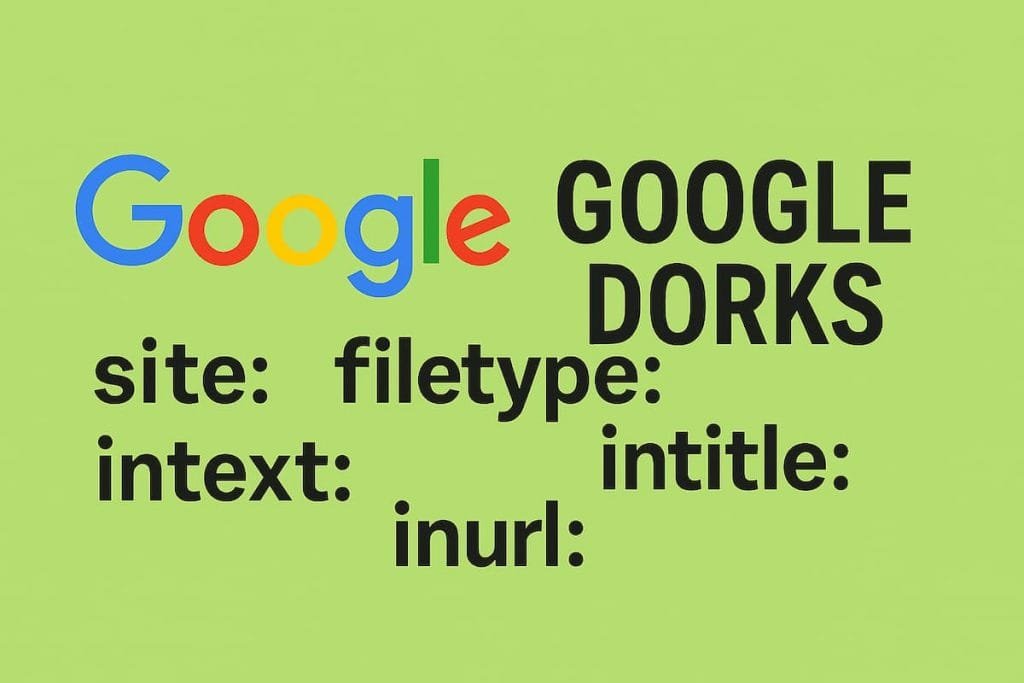
While OSINT covers many sources, Google Dorking (or Google Hacking) is the surgical use of search operators to find data Google indexed but was never meant to be public. By 2025, this has become a fundamental skill for security auditors trying to beat attackers to the punch.
Anatomy of an Advanced Query
The power of Google Dorking lies in combining operators to filter out noise and target technical assets.
- site: Limits results to a specific domain (e.g.,
site:govfor government sites). - filetype: or ext: Finds specific formats like PDF, SQL, or.env files.
- intitle: Searches for text in the page title, useful for finding directory listings (e.g.,
intitle:"index of"). - inurl: Targets keywords in the URL path, often used to find login portals.
- intext: Scans only the visible body text of a page for specific strings.
- cache: Shows the last version Google saved, helpful for viewing removed data.
Using quotes ("phrase") for exact matches and the minus sign (-) to exclude terms allows for incredible precision.
The Google Hacking Database (GHDB)
The GHDB, maintained by Exploit-DB, is a massive repository of pre-made dorks designed to find vulnerabilities. In 2025, the most critical entries target:
- Cloud Storage: Finding exposed AWS S3 or Azure Blob storage buckets.
- API Keys: Dorks that uncover hardcoded keys for AI services like OpenAI or Claude.
- Dev Environments: Locating staging sites that often have weaker security than production.
Practical Tutorial: Auditing Vulnerabilities
To understand the impact, look at how a security professional might use these techniques during a sanctioned audit.
Scenario 1: Finding Exposed AI API Keys
With the AI boom, many developers paste keys into shared ChatGPT conversations for debugging. Analysts use: site:chatgpt.com/share "OpenAI API Key" This has revealed thousands of live keys publicly indexed and ready for abuse.
Scenario 2: Detecting Cloud Storage Misconfigurations
Cloud buckets often leak data because of simple setup errors. A dork like: site:s3.amazonaws.com "confidential" companyname can reveal terabytes of internal data simply because the “Private” setting was missed.
Scenario 3: Hunting for Database Backups
Developers sometimes leave SQL dumps on public servers. A lethal combination is: filetype:sql "password" "INSERT INTO" site:example.com This can reveal plain-text credentials and the entire database structure.
| Audit Goal | Example Dork | Target |
| Sensitive Docs | site:example.com filetype:pdf "internal use only" | Internal procedures |
| Login Portals | inurl:admin site:example.com | Unprotected entry points |
| Config Files | filetype:env "DB_PASSWORD" site:example.com | Database credentials |
| Exposed Backups | intitle:"index of" "backup.zip" | Full site archives |
| IoT Devices | intitle:"webcamXP 5" | Accessible security cameras |
International Case Study: The SARI Controversy in Italy
In 2025, the debate over privacy and security reached a boiling point with Italy’s SARI (Automated Image Recognition System). The Italian Data Protection Authority (Garante) officially blocked the “Real Time” version of the system.
The ruling stated that live facial recognition in public spaces lacks a legal basis for indiscriminate biometric processing. It was labeled a form of “mass surveillance” that risks tracking every citizen regardless of suspicion. However, the “Enterprise” version, which analyzes images after the fact during investigations, was deemed compliant. This case serves as a warning for US policymakers on the balance between AI-driven policing and civil liberties.
Defense Strategies: How to Block Dorking and OSINT
Being aware of your exposure is only half the battle. Mitigating risk requires a layered technical approach.
Technical Mitigation: Robots.txt and Meta Tags
While the robots.txt file tells “good” crawlers what to ignore, it also acts as a map for attackers. For real protection, use the HTML meta tag:
explicitly tells Google not to index the page or follow its links.
Access Control and Authentication
The ultimate defense is simple: if data is sensitive, it must be behind a login. Implementing Multi-Factor Authentication (MFA) or transitioning to “Passwordless” systems (Passkeys) is no longer optional—it is the only way to stop 97% of identity-based attacks.
Active Monitoring
Organizations must “dork themselves.” Regularly running Google Dorking audits against your own domains allows you to find leaks before a criminal does. If a leak is found, use the Google Search Console to request immediate removal from the cache and search results.
The Future: Beyond 2025
By the end of this year, connected devices will generate 79 zettabytes of data, providing an infinite surface for OSINT attacks. AI will be both the weapon and the shield. AI-driven defense systems can now scan trillions of signals daily to identify early warning signs of an attack. However, nation-state actors are equally fast, using AI to flood the web with synthetic media to manipulate public perception.
In this landscape, Google Dorking and OSINT remain foundational. Transparency is the web’s greatest strength and its most dangerous vulnerability. Success in 2025 belongs to those who stop hoping they aren’t targets and start looking at their infrastructure through the eyes of the investigator.
Want to see if your data is exposed in 2025? Don’t wait for a breach notification. Start your first audit today. Prevention is the only real cure in a world where nothing stays hidden forever.
Join our community and subscribe:
-Newsletter: https://projectosint.substack.com/
-Telegram: https://t.me/osintprojectgroup