Protests without a breaking point
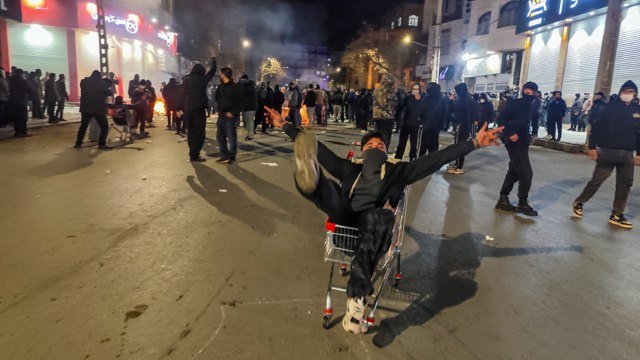
Street protests returned across Iran at the turn of 2026, spreading quickly from Tehran to dozens of provinces. Images of unrest suggest momentum. Numbers tell a more restrained story.
According to open-source assessments, protest activity alone is unlikely to trigger the overthrow or collapse of the Iranian government in the immediate term, defined as the following four weeks after early January 2026. The risk of escalation remains real, but scale does not automatically translate into regime change.
What sparked the protests
The immediate trigger was economic.
Between late December 2025 and early January 2026, the Iranian rial depreciated sharply, reaching approximately IRR 1.45 million per US dollar. This shock translated into sudden cost-of-living pressure, especially in urban areas.
Between 28 December and 8 January, at least 274 verified protest events were recorded nationwide. The majority were linked directly to economic grievances. Many, however, overlapped with broader anti-government sentiment, showing how financial stress quickly merges with political frustration in Iran.
Scale does not equal coordination
A fragmented protest landscape
Protest activity was geographically widespread, covering 27 provinces. Tehran remained the central hub, both symbolically and numerically, followed by provinces such as Isfahan and Kermanshah.
Yet the movement showed limited coordination.
Most actions took the form of demonstrations, marches, and sit-ins. Violent incidents increased after 7 January, but remained unevenly distributed. Ilam province recorded the highest level of protest-related violence despite a lower number of overall events, highlighting a mismatch between intensity and frequency.
Why this matters
Regime-threatening protest movements typically require sustained leadership, organisational depth, and cross-sector mobilisation. None of these elements are clearly present at this stage.
Economic anger mobilises crowds. It does not automatically produce political structure.
The state’s response: containment, not collapse
Iranian authorities have so far relied on selective containment rather than indiscriminate repression.
Security forces conducted targeted operations, including crowd dispersal and arrests, with 23 recorded security interventions linked to protest activity. One notable operation in Yasouj resulted in the arrest of 85 civilians.
The relatively low number of recorded attacks and the continued predominance of non-violent protest actions indicate a deliberate attempt to manage unrest without triggering nationwide escalation.
This approach reflects a familiar pattern: absorb pressure, fragment momentum, and prevent protest convergence.
Political escalation: a risk, not a certainty
Protest messaging evolved during early January. Economic demands increasingly overlapped with political slogans, including references to Reza Pahlavi. This shift raises the ceiling of confrontation, but does not guarantee it will be reached.
The key risk lies in miscalculation.
Large protest weekends, such as those on 10–11 January, act as stress tests. A sharp rise in casualties or heavy-handed repression could accelerate radicalisation. Absent that, protests are more likely to fluctuate rather than explode.
Why regime collapse remains unlikely
Three structural factors limit the immediate threat to the government:
First, the security apparatus remains intact and cohesive.
Second, protest activity lacks unified leadership and strategic direction.
Third, the state retains room to offer limited political or economic concessions to diffuse pressure.
For these reasons, the most likely short-term outcome remains managed containment rather than overthrow.
What to watch next
The situation remains fluid. Indicators worth monitoring include:
• sustained increases in violent clashes
• defections within security forces
• nationwide strike coordination
• loss of control over major urban centres
Absent these signals, unrest will continue to pressure the system without breaking it.
A familiar pattern, with real risks
Iran’s protests in early 2026 reflect deep economic strain and persistent political frustration. They expose vulnerability, not imminent collapse.
The danger lies less in revolution than in escalation without resolution. Prolonged unrest, even when contained, carries costs for stability, legitimacy, and regional security.
Understanding that distinction matters. It separates dramatic headlines from realistic risk assessment.
Want more grounded analysis on geopolitics, OSINT, and security trends?
Subscribe and join the community:
Newsletter: https://coondivido.substack.com/
Telegram: https://t.me/osintaipertutti
Telegram: https://t.me/osintprojectgroup