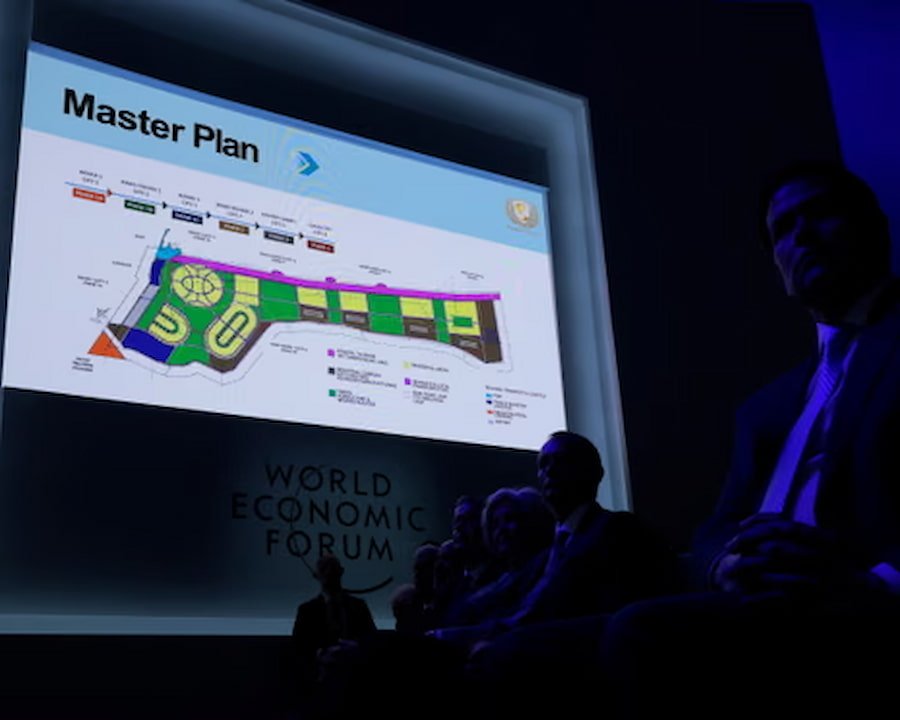
Can a real estate masterplan replace political rights? That’s the question at the heart of Jared Kushner’s Gaza reconstruction project, unveiled at Davos in January 2026. While diplomatic channels discuss ceasefires, a parallel track emerges: transforming the enclave through private capital, military contractors, and urban engineering that sidesteps Palestinian political demands entirely.
This isn’t traditional post-conflict rebuilding. OSINT analysis of the Peace Council framework reveals a model where profit-driven investment replaces multilateral intervention, and where “deradicalization” becomes architectural strategy.
The Peace Council: A Parallel UN Without Palestinian Representation
Trump’s Peace Council positions itself as an alternative to the United Nations for conflict resolution. The founding charter makes no mention of Gaza specifically, yet speaks of “a more agile and effective international peace-building body” with “the courage to distance itself from institutions that have too often failed.”
The power structure concentrates authority in Trump’s hands: he chairs for life, determines membership, and sets the agenda. Council members include figures with deep Israeli ties—Tony Blair, Secretary of State Marco Rubio, Steve Witkoff, Israeli billionaire Yakir Gabay—alongside major investors with Gulf interests.
Palestinians have zero representation. The subordinate National Committee for the Administration of Gaza (NCAG) functions as an executor, not a partner.
From Rubble to Resort: The Masterplan’s Geographic Logic
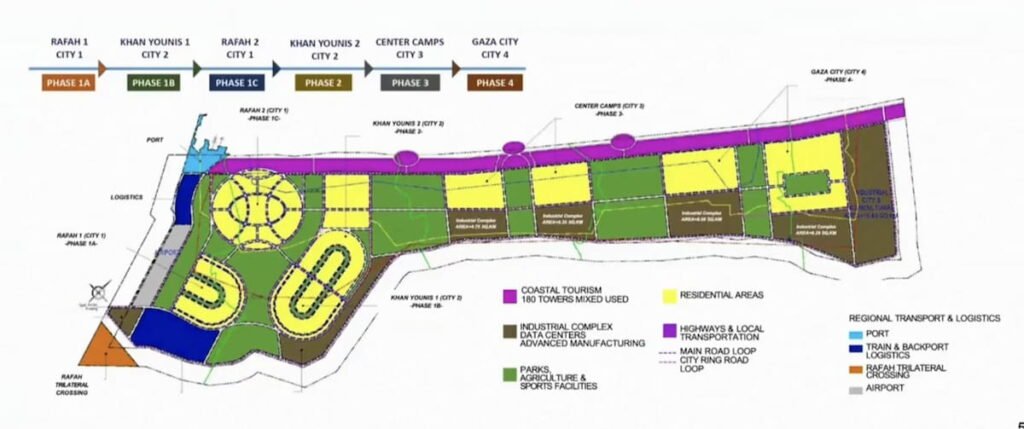
Kushner’s blueprint treats Gaza as blank canvas. Coastal zones become tourism corridors. Residential areas for Palestinians occupy the immediate interior, interspersed with parks and agricultural zones meant to project normalcy.
Industrial complexes and data centers cluster near the internal perimeter, dependent on Israeli supply chains and energy. A buffer zone rings the entire border under Israeli control. The demographic and logistical center shifts south, anchored by a port and airport near the southern boundary.
This isn’t incremental reconstruction starting from Israeli-controlled territory. The plan demands full demilitarization before any building begins—a “catastrophic success” strategy, in Kushner’s words. “We don’t have a Plan B.”
The Demilitarization Problem: Amnesty or Armed Clearance?
The plan theoretically offers Hamas fighters amnesty in exchange for disarmament, with “safe transfer” to other countries or selective integration into the NCAG technocratic government. Hamas wants to integrate its 10,000 police officers and over 40,000 government employees into the new security apparatus. Netanyahu’s government will almost certainly block this.
Elliott Abrams—veteran of Iran-Contra, the Iraq invasion, the 2007 anti-Hamas coup attempt, and regime change operations in Venezuela—hints at a harsher alternative. No country has volunteered troops for the stabilization force. Private contractors could handle the “cleanup” instead.
Abrams’ scenario: encourage civilians to relocate to Israeli-controlled zones while contractors “sanitize” Hamas infrastructure and fighters. The first “gated community” would rise in Rafah, funded by the UAE. Entry requires biometric screening, digital shekel currency, and UAE-designed school curricula promoting “deradicalization.” These measures aim to prevent Hamas infiltration, fund diversion, or ideological influence.
The stabilization force and NCAG police would control only these cleared zones. Trump appointed General Jasper Jeffers—former head of the Joint Special Operations Command (JSOC)—to lead the force. Jeffers specialized in Iraq and Afghanistan operations. His JSOC background suggests contractor deployment and training of Palestinian commandos recruited from Israeli-armed militias already fighting Hamas.
Contractors already operate in Gaza through the controversial Gaza Humanitarian Foundation (GHF), responsible for hundreds of civilian deaths at food distribution centers. One GHF architect, Aryeh Lightstone, now serves as Peace Council advisor.
Another contentious appointment: Sami Nasman as NCAG security chief. The former Palestinian Authority general was sentenced in absentia to 15 years by a Gaza court in 2016 for espionage and recruiting armed cells to destabilize Hamas.
Israeli Countermoves: Preparing for War, Not Reconstruction
Netanyahu’s government may sabotage the American plan outright. Israeli outlet Maariv reports the military has constructed dozens of outposts in the Israeli-controlled zone, connecting them to Israeli territory via new roads. The “yellow line” separating this zone from Hamas areas is becoming a fortified border with trenches and earthworks.
Military planners are preparing a possible offensive on Gaza City by March if the disarmament plan stalls. Netanyahu stated that the next phase concerns demilitarization, not reconstruction. Former Shin Bet director and current minister Avi Dichter declared: “We must prepare for war in Gaza. The disarmament question will be resolved by Israeli troops, through force.”
OSINT Implications: Tracking Capital Flows and Contractor Networks
From an OSINT perspective, several monitoring priorities emerge:
Contractor identification: Which private military companies secure contracts? Track hiring patterns, equipment shipments, and personnel movements through LinkedIn job postings, cargo manifests, and flight tracking databases.
Financial flows: Apollo Global Management CEO Marc Rowan sits on the Peace Council. UAE funding for Rafah’s gated community represents the first confirmed capital commitment. Monitor corporate filings, Gulf investment fund announcements, and World Bank alternative financing mechanisms.
Biometric systems: Which vendors supply the identity verification infrastructure? Look for procurement contracts, technology partnerships with Israeli security firms, and pilot programs in UAE-administered zones.
Demographic shifts: Satellite imagery analysis can track construction in Israeli-controlled zones, population density changes, and infrastructure development patterns inconsistent with stated reconstruction timelines.
Information operations: Track social media campaigns promoting voluntary relocation, NCAG messaging, and counter-narratives from Hamas or Palestinian civil society. Telegram channels, Twitter/X accounts linked to involved parties, and Arabic-language news outlets offer real-time sentiment indicators.
The Investor-Led Conflict Resolution Experiment
Gaza becomes the testing ground for a profit-driven alternative to traditional peacebuilding. The model assumes that political grievances yield to economic opportunity, that investor confidence matters more than political legitimacy, and that privatized security can replace international law.
This represents a fundamental shift: from rights-based frameworks to capital-based frameworks, from multilateral institutions to billionaire-led councils, from political negotiations to social engineering through urban design.
The Peace Council’s charter extends beyond Gaza to Venezuela and Ukraine, positioning this Gaza experiment as a prototype for wider application. Whether it s쳮ds or collapses into renewed violence, the precedent matters.
Elliott Abrams’ track record—failed coups, destabilized regions, scandals—doesn’t inspire confidence. Kushner’s real estate background offers deal-making skills, not conflict resolution expertise. The absence of Palestinian political agency in the process guarantees resistance.
OSINT practitioners should monitor this closely. The intersection of private military contractors, Gulf capital, biometric control systems, and displaced populations creates a landscape ripe for human rights abuses, financial opacity, and escalation risks that traditional diplomatic channels won’t capture.
The question isn’t just whether this plan rebuilds Gaza. It’s whether this model becomes the template for how powerful states and investors reshape conflict zones in the 21st century—bypassing international law, sidelining affected populations, and treating war zones as investment opportunities.
Want to stay ahead of geopolitical developments?
Join our community:
- Newsletter: https://coondivido.substack.com/
- Telegram: https://t.me/osintprojectgroup
Track the Gaza reconstruction through OSINT tools, satellite imagery analysis, and financial flow monitoring. The real story emerges not from official statements, but from contractor movements, capital commitments, and on-the-ground implementation patterns.