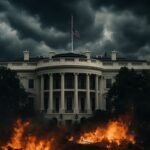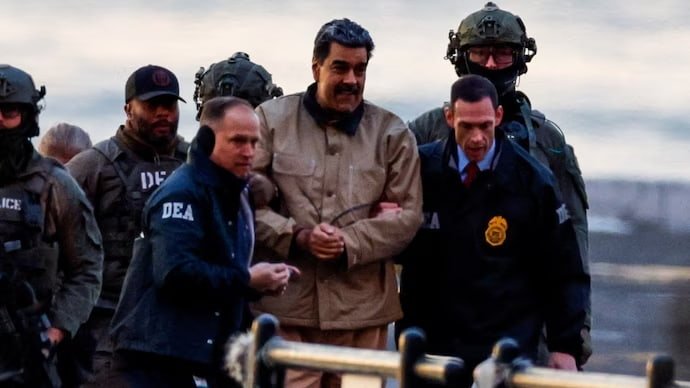
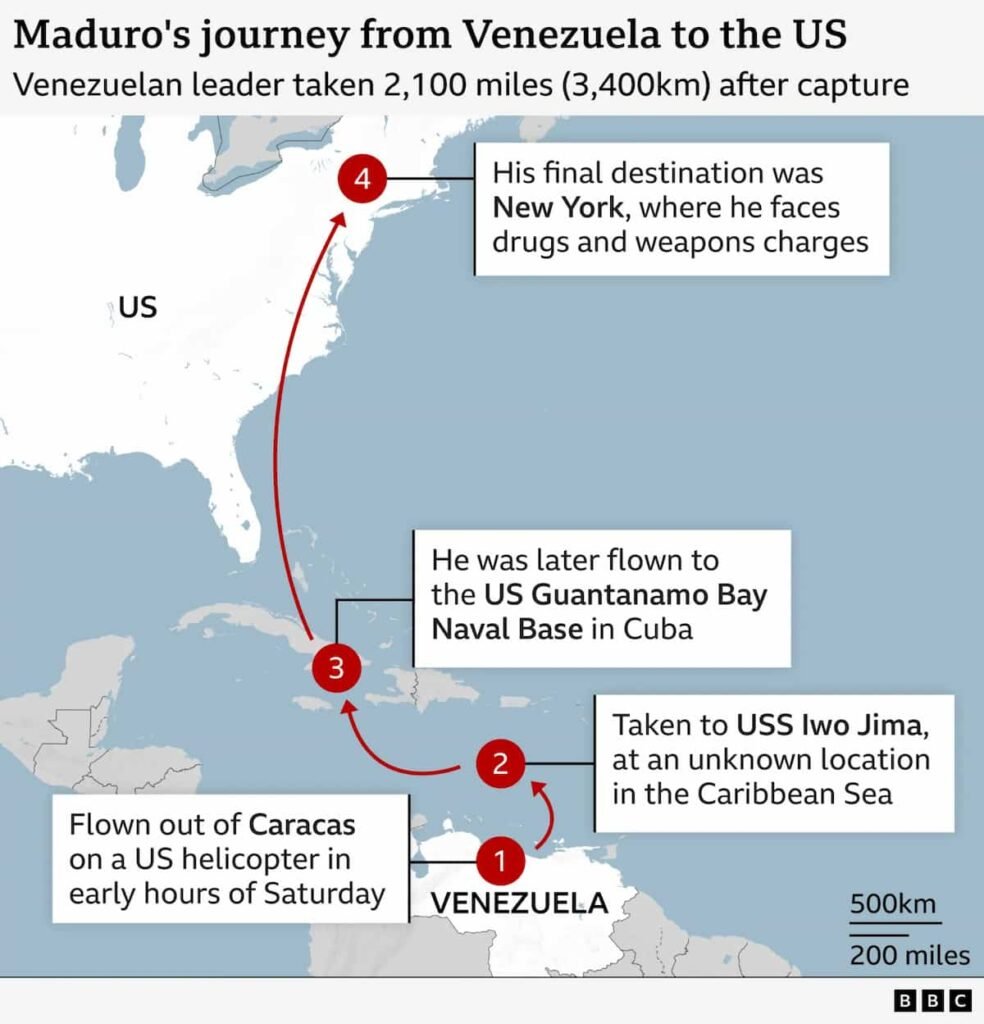
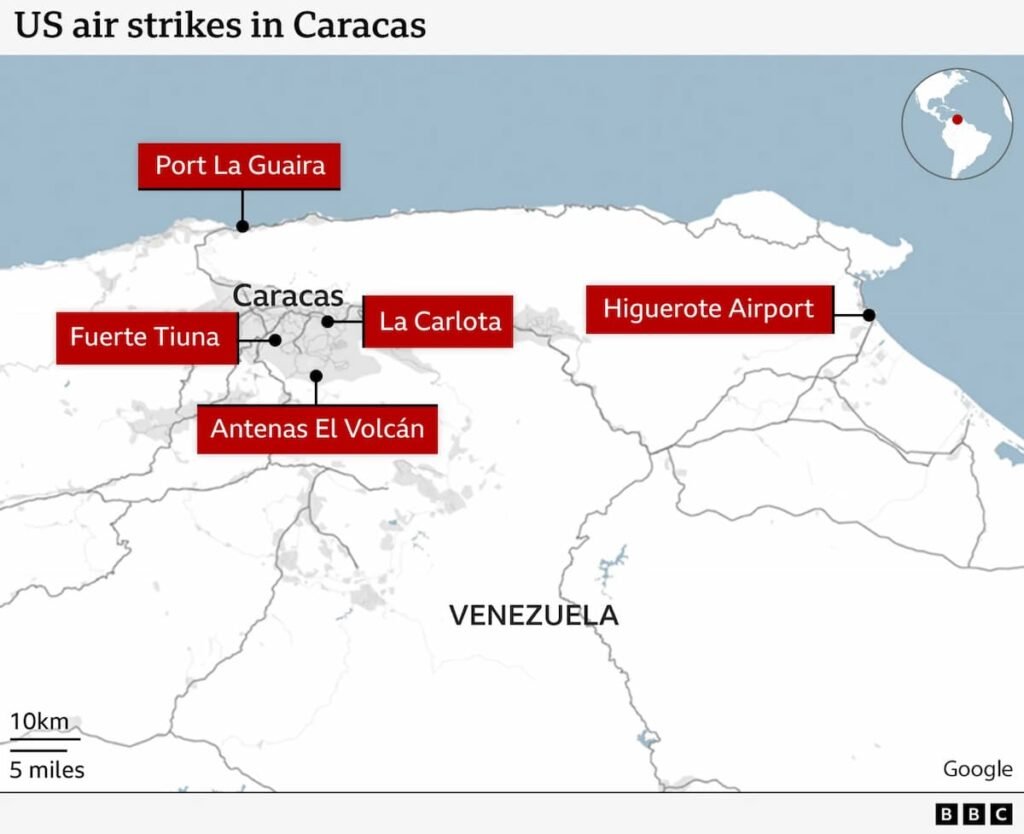
On January 3, 2026, a meticulously planned U.S. operation culminated in the capture of Venezuelan President Nicolás Maduro and his wife, Cilia Flores, dramatically altering the geopolitical landscape of Latin America. Using satellite imagery and visual verification, OSINT analysts reconstructed the sequence of events — from the strike in Caracas to the detention in Brooklyn — revealing how a 150-minute multinational mission brought one of the Western Hemisphere’s longest-serving leaders into U.S. custody.
A High-Precision Operation
D믭 Operation Absolute Resolve, the mission involved a coordinated effort of air, sea, and ground forces. Within approximately 150 minutes, elite U.S. units — including elements believed to be from Delta Force — executed a precise nighttime airborne raid on Maduro’s residence in Caracas. Maduro and Flores were swiftly taken into custody and flown to New York City to face federal charges.
According to Indian media reconstruction, the operation’s success hinged on a seamless blend of aircraft, intelligence support, and special operations tactics that U.S. President Donald Trump compared to “assaults like people have not seen since World War II.”
Federal Charges in the U.S.
Upon arrival, Maduro and Flores were indicted in the Southern District of New York on charges related to narcoterrorism — specifically allegations of cocaine trafficking and association with organized criminal networks. Both pleaded not guilty during their first court appearance on January 5, asserting their innocence and challenging the legality of the U.S. actions.
The case, formally titled United States v. Maduro et al., has roots in longstanding U.S. investigations dating back years, with the Department of Justice accusing Maduro’s regime of leading a conspiracy to traffic massive quantities of cocaine into the United States.
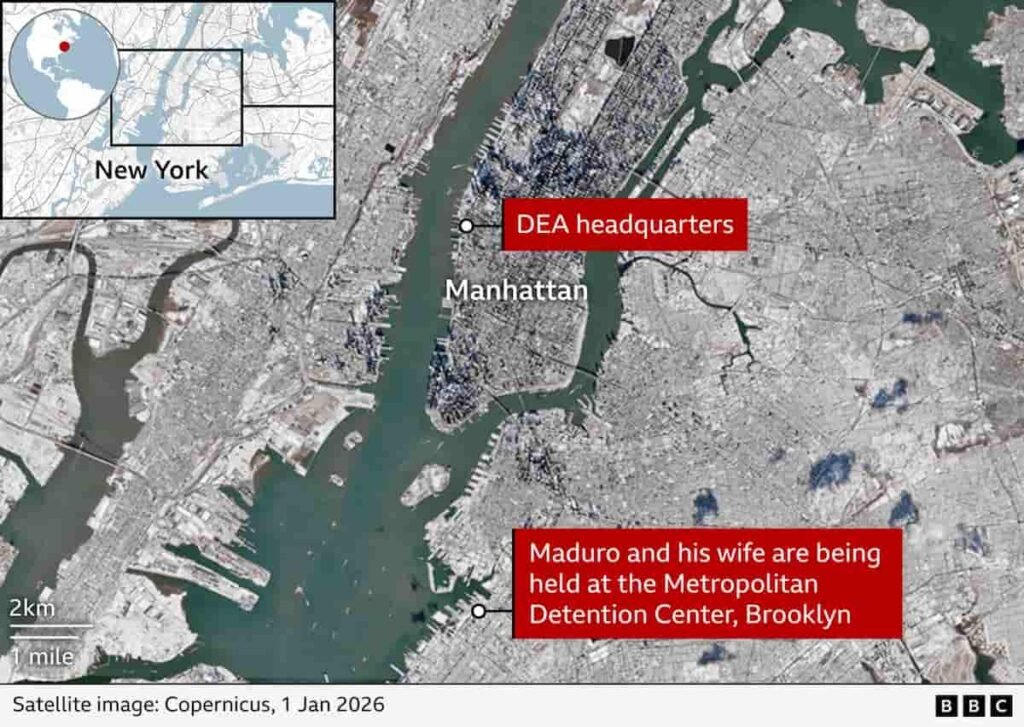
From Political Leader to Federal Custody
Maduro’s transfer to the Metropolitan Detention Center (MDC) in Brooklyn marks an unprecedented moment in modern international relations: a sitting head of state taken from his capital and held on U.S. soil. The MDC is known for housing high-profile inmates and has faced scrutiny over its conditions, ranging from overcrowding and poor healthcare to safety concerns.
During his court hearing, Maduro and his defense attorneys argued that the operation constituted a “kidnapping” and maintained that he remains the constitutional president of Venezuela. Meanwhile, Venezuelan interim leader Delcy Rodríguez has condemned the U.S. intervention, demanding Maduro’s release and decrying the action as a breach of international law.
Global Reactions and Legal Complexities
The arrest has sparked international controversy. Several nations, including China, have labelled the operation a violation of Venezuela’s sovereignty and called for dialogue rather than coercive measures. At the same time, critics argue that the U.S. action sets a bold — and potentially dangerous — precedent in foreign relations and international law.
Legal experts also anticipate that Maduro’s defense may pursue claims of head-of-state immunity, though this doctrine is complicated by the fact that the United States has not recognized his presidency since 2019 — a factor that could significantly influence the court’s deliberations.
Aftermath in Venezuela
Back in Venezuela, the political environment remains charged. Reports suggest armed militias and security forces have increased patrols across Caracas, while the government has declared mourning and insisted on public order amid the upheaval.
Meanwhile, Venezuelan diasporas around the world are divided: celebrations erupt among opposition groups, while supporters of Maduro decry foreign interference and organize protests both domestically and abroad.
What Comes Next
Maduro’s detention and pending trial represent a seismic shift in how the United States approaches foreign leaders it accuses of criminal conduct. Analysts warn the case could redefine the boundaries between international law enforcement and national sovereignty, with implications far beyond Venezuela’s borders.
Whether this moment leads to accountability or enduring diplomatic fractures, the world will watch closely as Brooklyn’s federal courthouse becomes the stage for one of the most consequential legal and political showdowns of the decade.