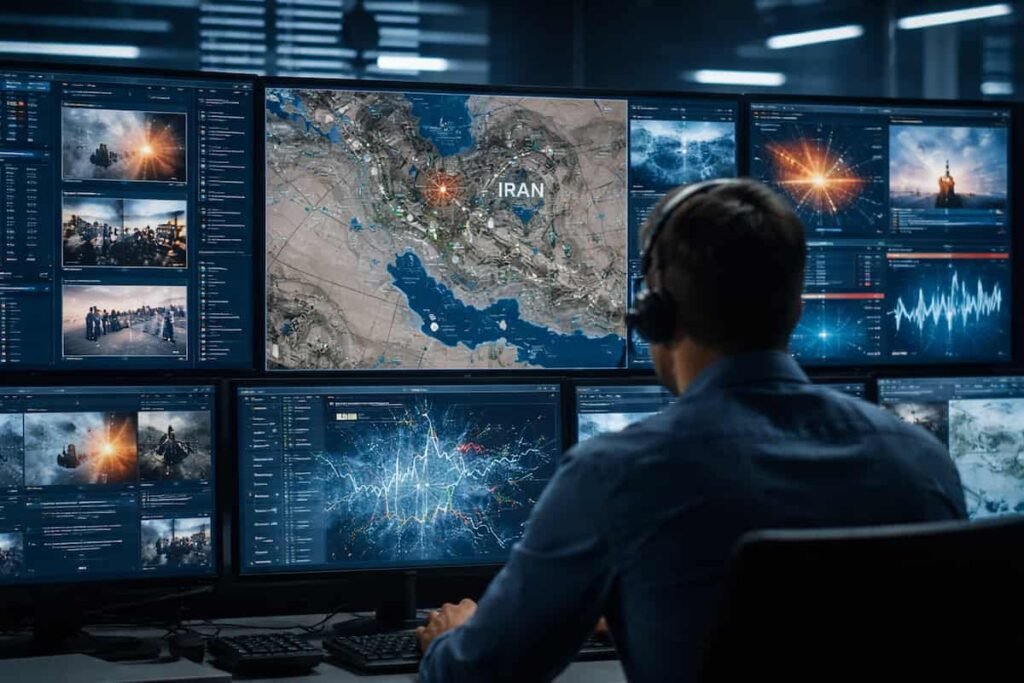
When missiles fly and official statements contradict each other, who sees the full picture first?
Not always governments.
Often, it’s analysts working with open sources.
Escalations involving Iran, US military bases in the Gulf, and Israeli territory have shown how fast narratives move. Social media explodes within minutes. State media frames events within hours. International outlets reshape the story by the evening.
In that window, open-source intelligence becomes decisive.
This article examines four practical OSINT tools for monitoring Iran, explains how professionals use them during crises, and highlights the risks nobody talks about.
Why OSINT is critical in the Iran–Middle East theater
Monitoring Iran today requires:
- Multilingual media tracking
- Rapid timeline reconstruction
- Cross-platform verification
- Geospatial correlation
Persian-language outlets may present events differently from Western media. Gulf-based reporting often reflects regional security concerns. Social media introduces raw footage long before official confirmation.
The challenge is not access.
The challenge is validation.
1. Persian Media Aggregators + Translation Plugins
Accessing primary Iranian narratives
One of the most effective starting points is a Persian-language media aggregator combined with browser translation extensions.
This setup allows analysts to:
- Read original Iranian headlines
- Compare wording before and after official statements
- Detect framing shifts in domestic discourse
Translation plugins provide operational speed, but nuance may disappear. Political rhetoric, cultural references, and sarcasm rarely survive automatic translation intact.
Practical workflow
If reports emerge of retaliation near a Gulf base:
- Check how Iranian outlets frame the event.
- Compare headline tone across multiple sources.
- Track whether wording changes within hours.
- Cross-check with international reporting.
Early narrative changes often reveal strategic messaging.
Strengths
Direct access to domestic discourse.
Editorial traceability.
Reduced reliance on secondary interpretation.
Weaknesses
Translation distortion.
Limited context without cultural literacy.
Risk of overinterpreting rhetorical language.
2. Real-Time Social and News Aggregators
Building a live timeline
Real-time aggregation platforms consolidate:
- Social media posts
- News agency dispatches
- Broadcast snippets
Their real value lies in chronological clarity.
In crisis situations, sequence matters more than opinion.
Who reported first?
What footage circulated before confirmation?
Which accounts amplified the claim?
Tactical advantages
- Consolidated multi-source monitoring
- Rapid detection of narrative surges
- Visibility of information flows
If an explosion video appears online, analysts can examine repost velocity, cross-platform spread, and account clustering.
Hidden limitation
Aggregation platforms often reflect particular analytical ecosystems. Some lean toward Western perspectives. Others amplify opposition voices.
Outputs must be treated as indicators, not conclusions.
3. Dashboard-Based Situational Awareness Systems
Visualizing spikes and anomalies
Advanced dashboards integrate:
- Social feeds
- Media reporting
- Event tracking maps
They display surges in mentions and highlight geographic clusters.
During multi-site incidents, visual dashboards help identify:
- Simultaneous reporting patterns
- Narrative shifts
- Coordinated amplification
Operational benefit
Dashboards compress complexity into a single interface.
Analysts can detect emerging themes without manually scanning dozens of feeds.
Critical risk
A spike in mentions does not equal confirmed escalation.
Online noise can inflate perception.
Visual intensity may create urgency where evidence remains thin.
Signal detection must always precede signal validation.
4. Geopolitical Mapping Platforms Focused on US–Iran Dynamics
Moving from noise to strategy
Unlike social-driven tools, mapping-based intelligence platforms integrate:
- Incident geolocation
- Military infrastructure overlays
- Regional strategic context
This changes the level of analysis.
Instead of asking, “What is trending?”
The question becomes, “How does this event alter regional posture?”
Strategic value
- Visualization of strike patterns
- Proximity analysis to US or Israeli assets
- Broader regional situational awareness
Mapping missile trajectories alongside base locations clarifies operational implications in ways text streams cannot.
Limitation
These platforms rely on open reporting.
They cannot substitute classified confirmation.
The SOCMINT Layer: Social Media Intelligence
Beyond specialized platforms, analysts must monitor:
- X accounts
- Telegram channels
- Instagram posts
- Regional discussion forums
These channels frequently surface early indicators.
They also host influence campaigns.
Professional SOCMINT demands:
- Source reliability scoring
- Cross-platform corroboration
- Time consistency checks
- Geographic verification
Without discipline, amplification looks like confirmation.
Verification Over Velocity
No single platform delivers a complete intelligence picture.
Professionals combine:
- Multilingual media monitoring
- Social aggregation
- Dashboard detection
- Geospatial mapping
Only after cross-verification do they draft assessments.
Speed attracts attention.
Accuracy builds credibility.
A Structured Monitoring Workflow for Iran
A disciplined analyst might:
- Start with Persian-language media review.
- Check real-time aggregators for emerging signals.
- Detect spikes through dashboards.
- Map incidents geographically.
- Cross-check across independent channels.
- Assign reliability levels.
- Draft a structured assessment.
Skipping verification saves minutes.
It costs reputation.
Pros and Cons of OSINT Tools for Monitoring Iran
What they deliver
- Fast multilingual access
- Early signal detection
- Narrative comparison
- Geospatial visualization
Where they fail
- Translation inaccuracies
- Narrative bias
- Amplification distortion
- Overreliance on dashboards
- Absence of classified validation
Technology accelerates collection.
Judgment remains human.
Why Training Still Matters
Tools evolve.
Influence operations evolve faster.
Analysts must understand:
- Propaganda framing techniques
- Regional political dynamics
- Military basing structures
- Online amplification patterns
Without analytical discipline, even the best OSINT tools for monitoring Iran become echo chambers.
The Bottom Line
Monitoring Iran and the Middle East through open sources demands skepticism, structure and context.
Dashboards highlight movement.
Maps show positioning.
Media aggregators reveal narrative shifts.
None of them think.
The analyst does.
Want to refine your analytical workflow and avoid common OSINT pitfalls?
Join our community:
Newsletter: https://projectosint.substack.com/
Telegram: https://t.me/osintprojectgroup
Serious analysis starts where automated feeds stop.