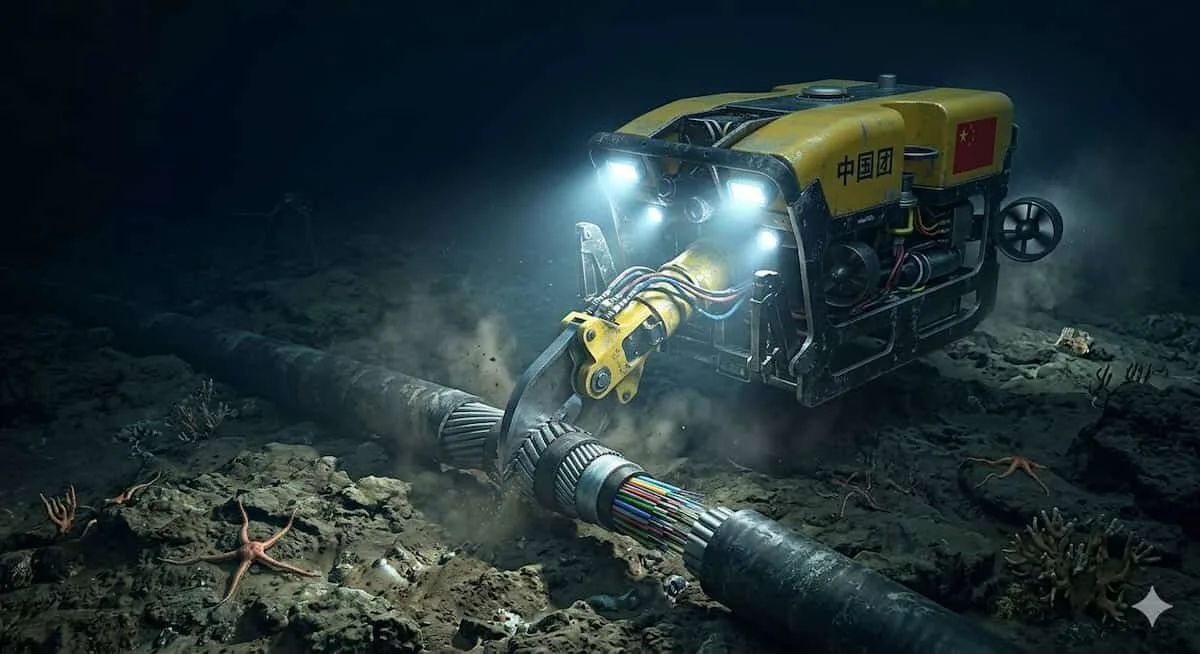

The Haiyang Dizhi 2 completed its first deep-water mission on April 11, 2025. Four days later, the South China Morning Post published the story. The sequence matters.
Not because of the timing — but because of what the public record, taken together, shows about a capability that Beijing has been building in plain sight for at least five years.
Why This Story Is Misread
Most coverage framed the EHA (Electro Hydrostatic Actuator) test as a weapons announcement. That’s the wrong frame. The device was not developed as an offensive tool. The paper trail goes back to pipeline repair: in 2022, Chinese engineering teams needed five hours to make a single cut on a 45cm damaged pipe section. By 2023, domestic systems could cut pipes up to 96cm in diameter at 600 meters depth — including a 20cm pipe cut in 20 minutes.
The 2025 test reaches 3,500 meters. That’s not a weapons program leak. It’s an engineering progression that happens to create a dual-use capability.
The distinction matters for OSINT analysis because it changes the investigation framework entirely. You’re not tracking a covert military program. You’re tracking a documented industrial capability that crosses a threshold.
System Map: What Is Publicly Known
The vessel:
The Haiyang Dizhi 2 (“Marine Geology 2”) is not a classified asset. It was built by CCCC Fourth Harbor Engineering Co., Ltd., a subsidiary of China Communications Construction Company Limited. Launched April 2022. Specifications are public: 85m length, 22m beam, 8m draft, 7,224-ton displacement, 12,000 nautical mile range.
Key equipment on record: a 150-ton active heave compensation crane, a 10km fiber optic winch, a geological sampling winch. It also functions as support vessel for the Meng Xiang, China’s first domestically designed ocean drilling ship.
None of this is classified. All of it is verifiable through corporate filings, maritime registries, and Chinese-language technical publications.
The device:
The EHA integrates a hydraulic system, electric motor, and control unit into a single package — no external oil tubing. Two hydraulic jaws grip the target to prevent rotational recoil during cutting. Power output: over 1 kW. Rated depth: 3,500 meters.
The September 2024 report cited by SCMP explicitly proposed this technology for “submarine cable cutting and deep-water grab bucket operation.” That report predates the April 2025 test by seven months. It was not hidden.
The 2020 precursor:
A team from Lishui University of Zhejiang developed a trawl-type submarine cable cutting device — anchor-shaped, serrated edges, designed to be dragged along the seabed behind a surface vessel. Low-cost. No ROV required. Equally effective for cable severance.
Two separate engineering paths, both documented, both converging on the same capability.
Operational Method: How to Investigate This
Step 1 — Vessel tracking
The Haiyang Dizhi 2 is a commercial research vessel. It appears in AIS (Automatic Identification System) data. Cross-reference: MarineTraffic, VesselFinder, and Chinese Maritime Safety Administration (MSA) notices. The April 11 mission location is recoverable from AIS history if you pull the data retroactively.
Verification logic: match AIS position data against the SCMP report date (April 15) and the mission completion date (April 11). Gap of four days between operational event and publication — standard for Chinese state-adjacent media.
Step 2 — Corporate registry tracing
CCCC Fourth Harbor Engineering Co., Ltd. is a publicly traceable entity. Parent company China Communications Construction Company Limited (CCCC) is listed on both the Shanghai Stock Exchange and Hong Kong Stock Exchange. Regulatory filings, subsidiary structures, and contract awards are accessible through Chinese corporate databases (Qichacha, Tianyancha) and international sanctions screening lists (CCCC was placed on the US Entity List in 2020).
Cross-check: procurement contracts for the Haiyang Dizhi 2 build against known CCCC subsidiaries and PLA-adjacent procurement channels.
Step 3 — Academic paper trail
The Lishui University 2020 trawl-cutter research and the September 2024 EHA report are academic publications. Search vectors: CNKI (China National Knowledge Infrastructure), Wanfang Data, and Google Scholar using Chinese-language terms for “submarine cable cutting device” (海底电缆切割装置) and “electro-hydrostatic actuator deep sea” (电液静压驱动器深海).
Both documents are in the open-source record. Neither requires access to classified systems.
Step 4 — Incident correlation
Map the documented cable-cutting incidents against vessel movements and geopolitical timelines:
- Baltic Sea incidents (2022–2024): suspected civilian vessels with Russian connections
- Red Sea cuts (2024): Iran-aligned actors suspected
- Taiwan Strait: multiple incidents, PRC accused directly
The OSINT question is not “did China do this” — it’s “does the documented capability match the observed incidents in terms of depth, method, and operational profile.” The 2020 trawl device (surface vessel, seabed dragging) fits shallow-water Baltic incidents. The 3,500m EHA fits a different target set entirely.
Step 5 — Infrastructure mapping
Submarine cable routes are public. TeleGeography’s Submarine Cable Map covers active and planned systems globally. Cross-referencing cable routes against the Haiyang Dizhi 2‘s operational range (12,000 nautical miles) and the April 11 test location produces a geographic threat assessment without any classified input.
Critical Issues
Attribution gap: The EHA test proves capability. It does not prove intent or prior use. Conflating the two is the primary analytical error in coverage of this story.
Dual-use problem: The same device used to cut a damaged pipeline at 600m in 2023 can cut a communications cable at 3,500m in 2025. Industrial certification and operational deployment are the same process. There is no clean line between civilian and military application here.
Coverage limitation: The SCMP report relies on a single Chinese-language technical document. Independent verification of the 3,500m rated depth — as opposed to tested depth — is not yet available in open sources.
Legal gray zone: Submarine infrastructure outside territorial waters sits in a regulatory vacuum. No international framework currently provides enforcement mechanism for cable sabotage in international waters. This is not a gap in knowledge — it’s a structural feature of the threat environment.
Analytical Layer
The progression is the signal. From five hours per cut at 600m in 2022 → 20 minutes at 600m in 2023 → rated capability at 3,500m in 2025. That’s not a breakthrough. That’s a roadmap.
The Lishui University trawl device (2020) and the EHA (2025) represent two different operational doctrines for the same objective. The trawl device is cheap, deniable, requires no deep-water ROV, and leaves ambiguous forensic signature. The EHA requires a purpose-built research vessel, produces a clean cut, and operates at depths where recovery and inspection are extremely difficult.
One is a gray zone tool. The other is a precision instrument.
The Haiyang Dizhi 2 also supports the Meng Xiang drilling platform. Deep-sea drilling and deep-sea cable cutting share the same logistics chain: vessel, crew, deep-water equipment deployment. The capability is not siloed.
Roughly 95% of global data traffic transits submarine cables. Future AI infrastructure — particularly the deep-sea cooling systems referenced in the source material — will extend this dependency further. The attack surface is expanding as the legal and surveillance framework remains static.
The British Royal Navy identified three Russian submarines near critical submarine infrastructure earlier this month. The Haiyang Dizhi 2 completed a deep-water test on April 11. These are separate events. The pattern they contribute to is not.
The EHA story is not about a single device. It’s about the maturation of a doctrine — hybrid operations against infrastructure that is legally unprotected, technically difficult to monitor, and strategically decisive.
The OSINT record on this is unusually complete. The vessel is trackable. The corporate chain is documented. The academic precursors are indexed. The incident history is mapped.
What’s missing is not information. It’s the analytical framework to connect engineering progression to operational intent — and the political will to treat infrastructure attacks at 3,500 meters with the same seriousness as attacks at sea level.
Project Osint
Join the community